
Electrical installation power balance — a practical guide for electricians
3 kwietnia 2026 | Electrical
The power balance is the foundation of every electrical installation design. Without a correct balance you cannot determine the connection capacity, size the protection devices, or design the main supply line. A mistake in the balance means either an oversized connection with unnecessary costs, or — worse — an overloaded installation.
This guide shows you step by step how to perform a power balance, which factors to use, and what to watch out for. If you want to go straight to the calculations, use our power balance calculator.
When do we perform a power balance?
A power balance is required when:
- New construction — application for grid connection conditions to the local DSO (Distribution System Operator)
- Building extension — increasing the connected power
- Change of use — e.g. from residential to office
- Installation modernisation — replacing the distribution board, changing the supply layout
The power balance document is an attachment to the grid connection application and the basis for equipment selection.
Basic concepts
Before we get to the calculations, a brief recap of the key quantities:
- Pi — installed power — the sum of the rated powers of all loads. This is the value taken from the nameplates
- Pz — demand power — power after applying the demand factor kz. Not all devices operate at full load
- Ps — peak (design) power — power after applying the diversity factor kj. Not all groups of loads operate simultaneously
- S — apparent power [kVA] — accounts for the reactive component (cos φ). This is the value that determines the size of the connection
- I — design current [A] — the current resulting from the apparent power, needed for sizing protection devices and cable cross-sections
Demand factor kz and diversity factor kj
Demand factor kz defines what fraction of the installed power is actually used. For example, socket outlets in an office — not all of them are loaded simultaneously at full power.
Diversity factor kj defines the probability of simultaneous operation of groups of loads. Lighting and air conditioning run together, but a lift does not run non-stop.
Formulas
Installed power of a single load:
where Pn — rated power, n — number of units, η — efficiency.
Demand power of a group:
Peak (design) power:
Apparent power:
Design current (three-phase system):
All of these calculations are performed automatically by our power balance calculator — just enter the loads and you get the result instantly.
Demand factor kz and diversity factor kj in practice
Selecting the factors is the most important decision in a power balance. Values that are too low result in an undersized installation; values that are too high mean unnecessary connection costs. The table below contains typical values used in design practice, consistent with the guidelines of Polish standard N SEP-E-002 and industry experience.
Office buildings
| Load category | kz | kj | cos φ |
|---|---|---|---|
| Lighting | 0.9 | 1.0 | 0.95 |
| Socket outlets | 0.7 | 0.2 | 0.9 |
| Air conditioning and ventilation | 0.8 | 0.9 | 0.85 |
| Electric heating | 1.0 | 0.9 | 1.0 |
| Lifts | 0.8 | 0.3 | 0.65 |
| Servers and UPS | 1.0 | 1.0 | 0.95 |
| EV chargers | 0.8 | 0.3 | 0.99 |
In residential buildings socket outlets have a lower kz (0.1), and air conditioning a higher kj (1.0). In industrial premises motors dominate — with kz = 0.7 and kj = 0.6 at a low cos φ = 0.8.
When to increase the factors? If the building has specific requirements (e.g. a server room with redundancy, a catering kitchen at full peak load), it is better to use higher values. For individual high-power loads (e.g. a single 22 kW EV charger) no reduction factors are applied — kz = kj = 1.0. When in doubt — consult your local DSO.
Step by step — how to perform a power balance
Step 1: Inventory of loads
List all electrical loads in the building, grouped by category:
- Lighting — LED luminaires, emergency, external
- Sockets — general purpose, dedicated (computers, printers)
- HVAC — air conditioners, fans, air handling units
- Heating — heaters, heating mats, heat pumps
- Motors — pumps, gate drives, compressors
- Special — lifts, servers, EV chargers, catering equipment
For each load record: rated power [kW], number of units, and phase configuration (1-phase / 3-phase).
Note on non-linear loads: Modern offices are full of switch-mode power supplies (computers, monitors, LED lighting) that generate higher-order harmonics. When there is a large proportion of such loads it is worth accounting for this when selecting the cross-section of the neutral conductor.
Step 2: Calculate installed power Pi
For each group, sum the powers of all loads. If a device has a stated efficiency (e.g. a motor η = 0.85), take it into account — the power drawn is higher than the shaft power.
Step 3: Select the factors and calculate Ps
Assign to each group the factors kz, kj, and cos φ from the table above (or adjust them to the specific building). Calculate the peak power Ps = Pi × kz × kj.
Step 4: Calculate apparent power S and current I
Sum the active and reactive powers of all groups (vectorially, not arithmetically!):
where
Step 5: Allow for a reserve
A standard reserve of 10–20% is used for future expansion. Do not overdo it — too large a reserve means a higher charge for the connected power.
Worked example — 500 m² office
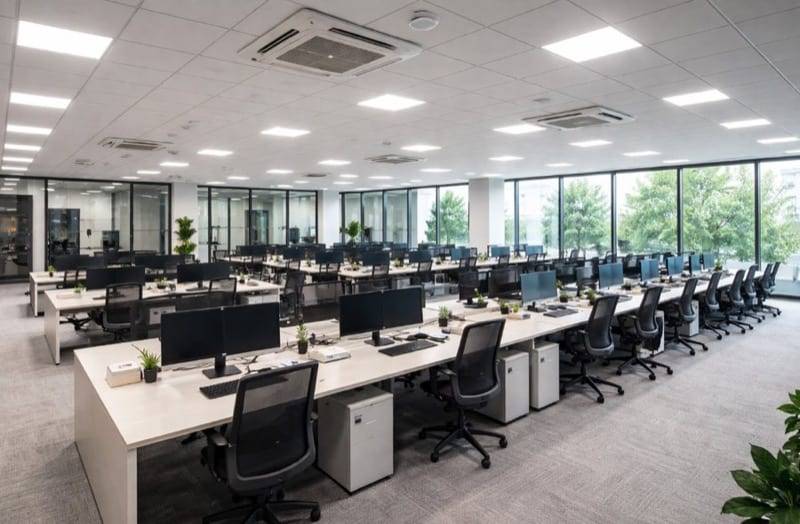
Let us calculate the power balance for a typical 500 m² office with the following loads:
| Group | Pi [kW] | kz | kj | cos φ | Ps [kW] | Q [kvar] |
|---|---|---|---|---|---|---|
| Lighting (LED, 10 W/m²) | 5.0 | 0.9 | 1.0 | 0.95 | 4.50 | 1.48 |
| Socket outlets (40 pcs × 0.2 kW) | 8.0 | 0.7 | 0.2 | 0.9 | 1.12 | 0.54 |
| Air conditioning (3 × 7 kW) | 21.0 | 0.8 | 0.9 | 0.85 | 15.12 | 9.37 |
| Server room (rack + UPS) | 6.0 | 1.0 | 1.0 | 0.95 | 6.00 | 1.97 |
| TOTAL | 40.0 | — | — | — | 26.74 | 13.36 |
Final calculations:
- Apparent power:
- Design current:
- Resultant cos φ:
With a 10% reserve: S = 32.9 kVA, I = 47.5 A.
Conclusion: for this office a connection of 40 kW with a 63 A main protection device is sufficient. It is also worth noting the cos φ = 0.89 — in larger office buildings with a significant amount of air conditioning and switch-mode power supplies, reactive power compensation may be necessary to avoid additional charges from the DSO.
Want to check your own calculations? Enter your loads in the power balance calculator and compare the results.

Most common mistakes in power balance calculations
1. Summing installed powers without applying any factors Taking Ps = Pi leads to a connected power that is several times too high and unnecessary costs. The factors kz and kj exist for a good reason.
2. An excessively large "just in case" reserve A reserve of 50% or more is a frequent mistake. The DSO charges for connected power — the higher the power, the higher the charge. The standard is 10–20%.
3. Arithmetic summation of apparent powers The apparent powers of individual groups do not add arithmetically. The active (P) and reactive (Q) components must be summed separately, and only then is the resultant S calculated. Otherwise the result will be overstated.
4. Ignoring cos φ At a low cos φ (e.g. induction motors — 0.65–0.8) the apparent power S is significantly higher than the active power P. Ignoring cos φ gives an underestimated design current and incorrectly sized protection devices.
Normative basis
The power balance is prepared in accordance with:
- N SEP-E-002 — Polish guideline for the design of electrical installations in residential buildings
- PN-HD 60364 — Low-voltage electrical installations
- Local DSO guidelines — individual distribution system operators may have additional requirements regarding the format and scope of the balance
For non-residential buildings (offices, industry, retail) there is no single mandatory standard — engineering best practice and the guidelines of the relevant DSO apply.
Frequently asked questions
What connected power is needed for a single-family house? Typical demand is 12–15 kW for a house without electric heating and 20–30 kW with a heat pump. A power balance will establish this precisely.
Does the power balance have to be prepared by a licensed designer? Formally, the power balance is part of the electrical installation design, which requires a construction licence in the electrical installation specialisation. In practice, the DSO accepts the power balance as an attachment to the grid connection application, signed by the designer.
What is the difference between connected power and demand power? Demand power (Pz) is the result of the balance — how much the building actually needs. Connected power is the value specified in the contract with the DSO, usually equal to or slightly above the apparent power S from the balance (including the reserve).
How should photovoltaics be included in the power balance? A PV installation does not reduce the connected power — the balance calculates the building's demand without taking generating sources into account. Photovoltaics require a separate notification to the DSO.
Summary
A power balance is not a complicated theory, but a concrete design tool. The key principles are:
- Group loads by category
- Select the kz and kj factors appropriate to the building type
- Sum powers vectorially (P and Q separately)
- Do not overdo the reserve — 10–20% is sufficient
- Consult the formal requirements with your local DSO
Perform your power balance quickly and accurately using our power balance calculator.
In future articles we will cover, among other topics, reactive power compensation, power balance in fire mode, and sizing protection devices from the power balance.
Back to articles list