
Heating media — water, glycol and dilution tables for installations
7 kwietnia 2026 | Heating
What flows in our pipes, radiators — generally in heating systems? Most often it is, of course, plain water. However, there are other fluids found in heating systems. These are primarily glycols, and in the past, brines. The choice of the appropriate heating medium has a direct impact on system performance, pump selection, pipe sizing, and the lifespan of the entire system.
If you are designing a heating system and want to check how the type of medium affects pipe diameter selection, use our heating pipe sizing calculator.
Water
The most commonly encountered fluid in installations. This is because it is the cheapest and most widely available liquid. Additionally, water has a high specific heat capacity of 4.2 kJ/(kg·K) — this value is higher than that of glycols. This physical property means that to transport a given thermal power, less water flow is needed compared to glycol. Furthermore, water has a lower viscosity than glycols, which directly affects the value of linear and local pressure losses in pipes and fittings. Both of these properties translate into the operating costs of circulation pumps.
Additionally, water is neutral to the environment and to human health. Any leaks are therefore not a problem in this regard. As for the pipes and fittings themselves, problems may arise after some time in the case of hard water. Fortunately, water softeners for boiler water and additives in the form of corrosion inhibitors are widely available to protect heating installations and equipment.
The only downside of using water as a heating medium appears in installations located outside buildings or in unheated rooms, where the temperature can drop below zero degrees Celsius and there are also periods of system downtime. The water in the pipes will then simply freeze. This has a destructive effect on fittings and pipes.
To prevent this, there are two solutions. Use a non-freezing fluid rated to the required negative temperature, e.g. down to -25°C, or wrap the pipes with electric heating cables and insulate them. Unfortunately, the second method is not 100% reliable — power supply interruptions or failures may occur.
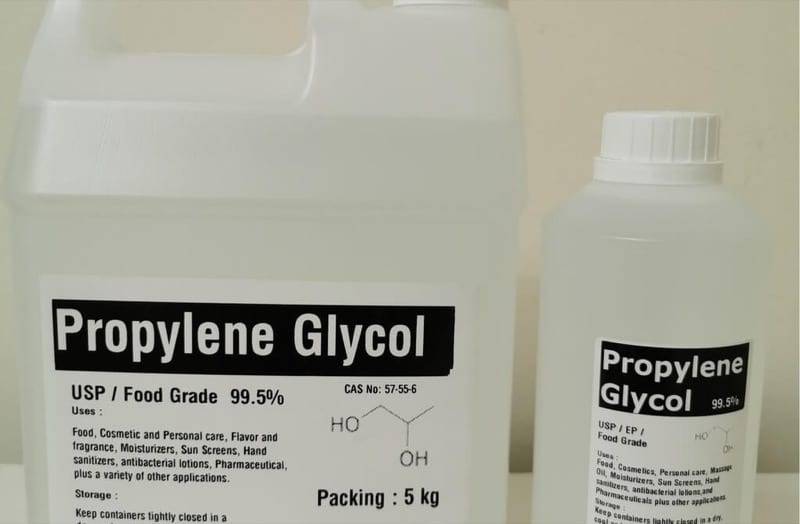
Propylene glycol
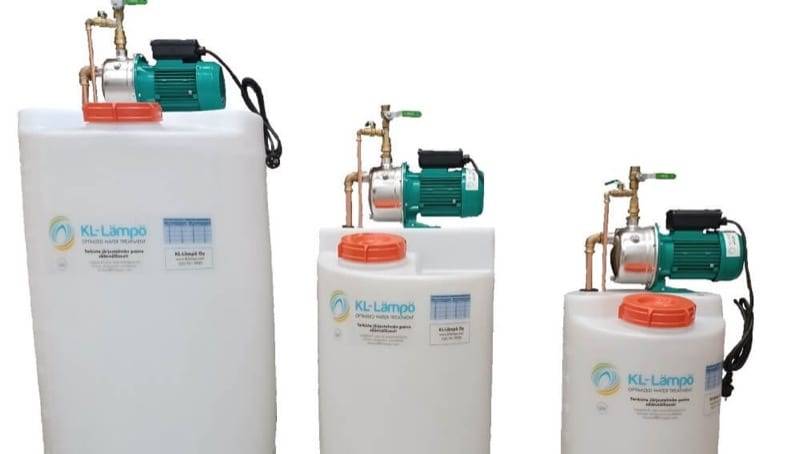 Glycol filling stations for
installations
Glycol filling stations for
installations
An organic chemical compound from the group of dihydroxy alcohols, i.e. diols. At room temperature, it is a colourless, odourless, oily liquid with a sweet taste and high viscosity. It is considered a compound harmless to health, or of very low toxicity. It has not been found to cause allergies, does not exhibit carcinogenicity, and is not mutagenic. Contact with undiluted propylene glycol may cause eye and skin irritation, but these are not serious and easily subside, usually upon cessation of contact. In the body, it is quickly converted into lactic acid (in a manner similar to how muscles convert sugar into energy). It is easily biodegradable in the environment. It is a safe substance even at a concentration of 50% in the finished preparation. In installations, glycol solutions of the appropriate concentration are used, depending on the temperature down to which we need our solution not to freeze.
| Parameter | 80% | 50% | 42% | 37% | 33% |
|---|---|---|---|---|---|
Glycol concentration [%] | 80 | 50 | 42 | 37 | 33 |
Crystallisation temp. [°C] | * | -35 | -25 | -20 | -15 |
Kin. viscosity [mm²/s] at 50°C | 6,02 | 2,14 | 1,61 | 1,31 | 1,18 |
Specific heat [kJ/(kg·K)] | 2,93 | 3,58 | 3,70 | 3,77 | 3,84 |
Table 1. Properties of propylene glycol depending on concentration
Ethylene glycol
An organic chemical compound that is the simplest polyhydroxy alcohol (diol), and also the simplest sugar alcohol. It is widely used as a component of automotive coolants, as well as a precursor for polymers. In pure form, it is a colourless, odourless, syrupy liquid with a sweet aftertaste. Ethylene glycol is toxic, and its ingestion can cause death. It is a harmful substance that has a depressive effect on the central nervous system. It irritates the mucous membranes of the nose and conjunctiva. The body absorbs it through the respiratory tract, skin, and the digestive tract. Through the digestive route, glycol initially causes symptoms similar to alcohol intoxication, then (after several or a dozen hours) leads to metabolic acidosis. When glycol is heated, the resulting vapour can lead to loss of consciousness, while in small concentrations it causes irritation of the nose and throat and headaches. It is therefore important to exercise particular caution when working with glycol.
| Parameter | 93% | 48% | 40% | 35% | 28% |
|---|---|---|---|---|---|
Glycol concentration [%] | 93 | 48 | 40 | 35 | 28 |
Crystallisation temp. [°C] | * | -35 | -25 | -20 | -15 |
Kin. viscosity [mm²/s] at 50°C | 6,53 | 1,59 | 1,43 | 1,08 | 0,94 |
Specific heat [kJ/(kg·K)] | 2,50 | 3,38 | 3,54 | 3,63 | 3,77 |
Table 2. Properties of ethylene glycol depending on concentration
Comparison of heating media
To facilitate the selection of the appropriate medium for a given installation, the key parameters of water, propylene glycol, and ethylene glycol are compared below — both glycols at a typical concentration providing protection down to -25°C.
| Parameter | Water | Propylene glycol 42% | Ethylene glycol 40% |
|---|---|---|---|
Density at 20°C [kg/m³] | 998 | 1 038 | 1 055 |
Specific heat [kJ/(kg·K)] | 4,19 | 3,70 | 3,54 |
Kin. viscosity at 50°C [mm²/s] | 0,55 | 1,61 | 1,43 |
Freezing point [°C] | 0 | -25 | -25 |
Toxicity | none | very low | high |
Approximate price | minimal | high | medium |
Table 3. Comparison of heating media with protection down to -25°C
Impact of the heating medium on flow — thermal power formula
The thermal power transported by the heating medium is described by the formula:
where:
- — thermal power [W],
- — mass flow rate [kg/s],
- — specific heat of the medium [kJ/(kg·K)],
- — temperature difference between supply and return [K].
From this formula, a key relationship follows: the lower the specific heat of the medium, the greater the flow required to transfer the same thermal power. For 42% propylene glycol ( = 3.70 kJ/(kg·K)) compared to water ( = 4.19 kJ/(kg·K)), the required mass flow is greater by:
This means that when switching from water to 42% propylene glycol, the flow must be increased by approximately 13%, which directly affects the pipe diameter selection and circulation pump capacity.
Disadvantages of glycols
Glycols have a higher viscosity than water, thus causing greater flow resistance in the installation. Additionally, they have a lower specific heat, which means that to deliver a given heating power, a greater flow of glycol is needed compared to water. These drawbacks result in higher flow resistance in the installation. These alcohols are also more expensive than water and require a different approach when constructing the system filling arrangement.
Due to its toxicity, ethylene glycol is more commonly used as an automotive coolant rather than in sanitary installations. In residential and public buildings, the use of propylene glycol is recommended exclusively due to its safety.
Impact of glycol on circulation pump selection
The higher viscosity of glycol compared to water means greater pressure losses in pipes and fittings. In design practice, it is assumed that pressure losses in a glycol-filled installation are 10–15% higher than in the case of water — depending on the glycol concentration and operating temperature.
When selecting a circulation pump for a glycol installation, the following must be taken into account:
- Higher required flow — resulting from the lower specific heat (as shown above, up to 13% more).
- Greater pressure losses — resulting from the higher viscosity of the medium.
- Higher glycol density — increasing the hydraulic load.
As a result, the pump for a glycol installation must have 15–25% more power than a pump selected for an identical installation operating on water. This should be considered already at the stage of heating system design to avoid undersizing.
Impact of glycol on heat exchangers
Glycol also affects the performance of heat exchangers — both plate and coil types. The lower specific heat and higher viscosity of glycol cause:
- Deterioration of the heat transfer coefficient — by as much as 15–20% compared to water.
- The need to increase the heat exchange surface area — to achieve the same power, the exchanger must have more plates or a longer coil.
- Increased pressure losses on the glycol side — which additionally loads the pump.
Heat exchanger manufacturers provide correction factors for various glycol concentrations in their catalogues. When selecting a heat exchanger for a glycol installation, these factors should always be checked and the unit should be appropriately oversized.
Glycol in solar installations
In solar collector installations, the use of glycol is practically mandatory. Solar collectors and pipes on the roof are exposed to sub-zero temperatures during winter, and at the same time to very high temperatures in summer (even above 200°C during stagnation).
In solar installations, propylene glycol is used at a concentration providing protection down to at least -25°C (in Poland — even down to -35°C in north-eastern regions). Solar preparations contain special corrosion inhibitors and thermal stabilisers that protect the glycol from degradation at high temperatures.
It is worth noting that glycol in a solar installation ages faster than in a standard heating installation due to the extreme operating conditions. Manufacturers recommend replacement every 3–5 years for solar installations, whereas in typical heating installations, glycol can operate for 5–8 years.
Glycol concentration selection
The glycol concentration is selected based on the minimum expected temperature in the installation. The principle is simple: the crystallisation temperature of the solution should be at least 5°C lower than the lowest anticipated operating temperature.
Practical example
We are designing a heating installation in an unheated garage in central Poland. The minimum winter temperature can drop to -20°C. Required crystallisation temperature of the solution:
From Table 1 (propylene glycol), we read that for protection down to -25°C, a concentration of 42% is needed. This means that for every 100 litres of solution, we need 42 litres of pure propylene glycol and 58 litres of water. The installation capacity can be determined using the pipe capacity calculator.
Excessively high glycol concentrations should not be used "as a reserve". A concentration above 50% causes a sharp increase in viscosity (and consequently — flow resistance), while the specific heat drops significantly. The optimal concentration is one that provides the required frost protection with minimal deterioration of hydraulic properties.
Filling and maintenance of glycol installations
Filling an installation with glycol requires a specialised approach, different from the case of water:
- Filling station — glycol is filled using a manual or electric pump with an appropriate mixing tank. The ready solution at the required concentration is prepared before filling.
- Venting — glycol is harder to vent than water due to its higher viscosity. The installation must be vented multiple times in the first days after filling.
- Filling pressure — the higher density of the glycol solution must be taken into account when setting the pressure. When selecting the expansion vessel, one must remember the increased expansion of glycol compared to water — the expansion coefficient of 42% propylene glycol is approximately 15–20% higher than that of water.
Periodic inspection and replacement
Glycol in a heating installation does not last indefinitely. Over time, it loses its protective properties:
- Service life — in typical heating installations, glycol requires replacement every 5–8 years. In solar installations — every 3–5 years.
- Concentration check — every 1–2 years, the glycol concentration should be checked with a refractometer. A drop in concentration below the required level means loss of frost protection.
- pH check — the pH of the solution should be 7.0–8.5. A drop below 7.0 indicates exhaustion of corrosion inhibitors and the need to replace the glycol.
- Colour check — darkening or cloudiness of the solution signals glycol degradation.
- Corrosion inhibitors — ready-made glycol preparations contain inhibitors that protect the installation from corrosion. Glycol should not be diluted with ordinary tap water — demineralised or softened water should be used.
Summary
Installations that have no contact with sub-zero temperatures are filled with water. This is the most optimal and straightforward solution — water has the highest specific heat, the lowest viscosity, and is the cheapest. For installations exposed to frost, it is best to use propylene glycol — it is safe, effective, and widely available in ready-to-dilute preparations.
Remember that using glycol requires accounting for its properties at every stage of design: from pipe diameter selection, through pump and heat exchanger sizing, to expansion vessel selection. Omitting these corrections is a common design error that leads to underheating of rooms and increased energy consumption.
Back to articles list