
Expansion Vessel Sizing for Heating Systems — Formulas, PN-B-02414, Calculator
9 kwietnia 2026 | Heating
An expansion vessel (also called a diaphragm expansion tank) is a component without which no closed heating system can operate safely. Its role is to compensate for the volume changes of the heating medium caused by temperature differences and to stabilise the system pressure. An undersized tank means constant safety valve discharge, pressure spikes and rapid membrane wear. An oversized tank means unnecessary cost and lost boiler room space. Correct sizing requires calculations compliant with standard PN-B-02414:1999, not just reading a value from a manufacturer's simplified table.
If you want to size an expansion vessel quickly without manual calculations, use our expansion vessel sizing calculator — fully compliant with PN-B-02414 and with a ready-to-print PDF report.
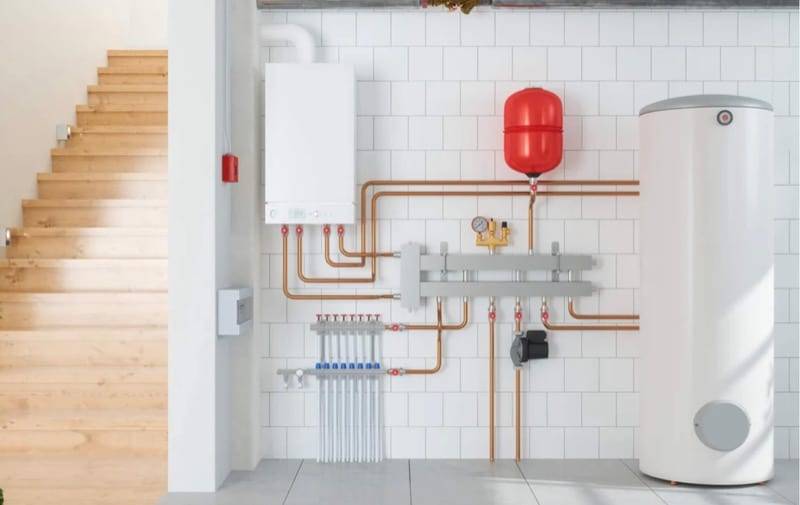
What an expansion vessel does and how it works
In a closed heating system, water heats up from the rest temperature (taken by the standard as ) to the design supply temperature , which is typically 70–80 °C for radiator systems and 35–45 °C for underfloor heating. As the temperature rises, the specific volume of water increases, and because the system is closed and water is practically incompressible, every additional litre of volume must fit somewhere. That is precisely the job of an expansion vessel.
Inside the vessel there is a flexible diaphragm (membrane) dividing the internal volume into two chambers: water and gas. The gas chamber is factory-filled with nitrogen or air at a pre-charge pressure (referred to as ), typically 1.0–1.5 bar. As water in the system expands, it pushes the membrane into the gas chamber, compressing the gas and keeping the system pressure within safe limits. When the system cools, the gas pushes the water back into the circuit.
A correctly sized expansion vessel keeps the system pressure between the initial working pressure and the safety valve opening pressure — it never drops to zero (preventing air ingress) and never reaches the valve setting (preventing discharge).
Consequences of incorrect sizing — why you should calculate
A tank sized "by eye" or copied from a neighbouring project is a typical mistake whose effects only show up after a few heating seasons. The most common symptoms are:
- Undersized tank: cyclic safety valve discharge every time the system heats up, frequent need to top up the system, pressure gauge pulsations, fitting failures from water hammer, premature membrane wear.
- Oversized tank: unnecessary investment cost, boiler room space issues, slightly slower pressure regulation response — but it's worth pointing out that an expansion tank cannot be "too big" from a safety point of view. When in doubt, err on the larger side.
- Pre-charge pressure too low: the tank works with a partially compressed membrane even at cold state, reducing its effective usable volume. This shows up as the safety valve opening quickly with only a small temperature rise.
- Pre-charge pressure too high: water cannot push the membrane in, the pressure gauge reads zero, the system entrains air, the circulation pump runs dry and fails quickly.
Each of these problems stems directly from skipping or simplifying the calculation. Standard PN-B-02414 provides an exact procedure that eliminates 90% of these mistakes.
CH and DHW tanks — never interchange
Diaphragm expansion vessels for central heating and for domestic hot water differ in membrane construction, identification colour and hygienic approval:
| Feature | Central heating | Domestic hot water |
|---|---|---|
Housing colour | red / maroon | white / blue |
Membrane material | standard EPDM | butyl with hygienic cert. |
Max. medium / connection temperature | up to 120 °C | up to 70 °C |
Typical | 3–6 bar | 6–10 bar |
Hygienic certificate | not required | required |
A note on membrane temperature: in both vessel types, the EPDM diaphragm itself has the same allowable working temperature — typically 70 °C. The higher medium temperatures shown in the table refer to the allowable temperature at the connection (flange) or body, not at the diaphragm itself. That is why CH vessels are always installed on the return (cooler water), often with an additional "U-tube" cooling loop between the system and the tank inlet.
The key practical conclusion: never use a CH expansion vessel in a drinking water system. A standard EPDM membrane without a hygienic certificate may release compounds affecting the taste, smell and health safety of water. On the other hand, DHW tanks are designed for lower temperatures (up to 70 °C) and should not be installed on a boiler loop where the medium runs hotter.
The rest of this article deals exclusively with sizing a tank for a closed central heating system per standard PN-B-02414.
Regulatory and standard basis
Sizing a diaphragm expansion vessel in a heating system is governed in Poland by the following documents:
- PN-B-02414:1999 — "Heating and district heating. Protection of closed water heating systems with diaphragm expansion vessels. Requirements". This is the fundamental standard providing formulas, limits and application conditions.
- PN-EN 12828 — European standard on the design of water heating systems in buildings, harmonising requirements across the entire heating system.
- Polish Building Regulations (WT) — refer to sector standards for heating system requirements.
Open systems are covered by a separate standard PN-91/B-02413 describing open expansion tanks with safety and signalling pipes. Open systems are however being phased out — for new installations with gas boilers, heat pumps and pellet boilers, closed systems with diaphragm expansion vessels are almost always used.
System volume V — how to estimate it
System water content [m³] is one of the two key input parameters (alongside temperature). In detailed design work, the volumes of the boiler or heat exchanger, all pipework (based on length and internal diameter) and all radiators (from manufacturer datasheets) are summed up.
Important methodological note: the popular "l/kW" multipliers must be applied to the building's design heat demand, not to the nominal power of the installed boiler. In single-family homes the boiler is almost always oversized — a typical 20–24 kW condensing boiler operates in a building whose actual heat demand is 8–14 kW. Applying the multiplier to boiler rated power leads to an overestimate of by 50–100% and therefore to an unnecessarily large tank.
Design heat demand can be estimated from the specific heat demand index [W/m²], depending on insulation standard:
| Building standard | Index [W/m²] |
|---|---|
Passive / energy-efficient | 15–30 |
New (modern standard, good insulation) | 30–50 |
Standard (after 2005) | 50–70 |
Older (1990s–2005) | 80–100 |
Old, uninsulated | 120–150 |
Design heat power is then: [W], where is the heated floor area [m²]. For a 150 m² house built after 2005: — and this is the value used to derive system volume, not the 20 kW nominal boiler output.
System volume is then estimated from a multiplier depending on the type of heat emitters:
| Heat emitter type | Approx. volume [l/kW] |
|---|---|
Steel panel radiators | 10–15 |
Aluminium sectional radiators | 15–18 |
Cast iron radiators | 18–25 |
Underfloor heating | 17–22 |
Fan coils | 5–8 |
Add the capacity of the heat source itself, which for typical single-function gas boilers ranges from 3–15 dm³ and can reach several dozen litres for boilers with an integrated buffer. If the system contains a hydraulic separator or buffer tank, its volume (often 200–800 l) dominates over the rest of the system and must be included in the calculation.
In practice, for a typical single-family home (panel radiators, post-2005 insulation standard) the system water content is:
- 100 m² house (6–8 kW design power): ~80–120 dm³
- 150 m² house (9–11 kW): ~130–170 dm³
- 180 m² house (11–13 kW): ~160–200 dm³
- 220 m² house (14–16 kW): ~200–250 dm³
When sizing a tank, remember that it's better to slightly overestimate by 10–20% than to underestimate it — the effect on the result is not linear, but overestimating always leads to a safer selection.
Calculation procedure per PN-B-02414
Standard PN-B-02414 provides a procedure for determining the volume of a diaphragm expansion vessel including the operational reserve for routine water losses (e.g. degassing, small leaks). The procedure consists of six interconnected formulas.
Minimum usable volume
The usable volume is the amount of water the tank must absorb as a result of thermal expansion of the system:
where:
- — system water content (boilers, pipes, radiators) [m³],
- — density of installation water at rest temperature , [kg/m³],
- — specific volume increase of water from to the design supply temperature [dm³/kg], read from the thermodynamic property tables of water.
For the most commonly encountered supply temperatures:
| Temperature [°C] | [dm³/kg] |
|---|---|
45 | 0.0096 |
55 | 0.0142 |
70 | 0.0224 |
75 | 0.0256 |
80 | 0.0287 |
90 | 0.0356 |
For glycol mixtures (antifreeze mixtures in heat pumps) the value of is 5–15% higher than for pure water — more accurate calculations require using the property tables of the specific glycol.
Minimum total volume
The usable volume must be increased by the gas reserve that remains permanently compressed — without this reserve the pressure would rise without limit. The standard provides the formula:
where:
- — usable volume from the previous formula [dm³],
- — maximum design pressure in the tank (most often the safety valve opening pressure) [bar],
- — pre-charge pressure in the gas chamber of the tank [bar].
The constant added to and represents atmospheric pressure — the formula uses absolute pressures.
Pre-charge pressure in the gas chamber
The pre-charge pressure is the value set at the factory or by the installer before the tank is connected to the system. It cannot be an arbitrary value — it must be sufficient to hold the column of water up to the highest point of the installation. For a tank connected to the suction side of the circulation pump:
where is the hydrostatic pressure at the level of the expansion tank connection at water temperature . In practice [bar], where is the height difference [m] between the tank connection and the highest point of the installation (usually the top-floor radiators). For a single-storey house , for a two-storey house , for a 4-storey apartment block .
For a tank connected to the discharge side of the circulation pump, the pre-charge pressure must additionally be increased by the pump head to prevent under-pressure on the suction side. In new installations, however, connecting the tank to the suction side is recommended — it is the safer solution and provides more stable operating conditions.
Usable volume with operational reserve
During normal operation a system experiences small water losses (e.g. through automatic air bleeders, seal leaks, degassing). The standard requires an operational reserve to be included:
where:
- — usable volume from the first formula [dm³],
- — system volume [m³],
- — operational leakage expressed as percentage of system volume. The standard recommends , with the higher value applying to systems with more air bleeders or older installations,
- the factor is a unit conversion (m³ to dm³ and percent).
Initial working pressure
When the reserve water fills the tank, the effective cold-state working pressure is higher than the tank's bare pre-charge pressure . The standard calls this value and gives it as:
is the pressure that should be set on the boiler room manometer at cold state — you read it off as information for the installer at system commissioning.
Total tank volume with reserve
The last formula gives the required total expansion tank volume including the operational reserve. This is the value from which we select the next larger standard commercial size:
where and are the values calculated in the previous steps.
Worked example step by step
To show the full calculation path in practice, let's consider a typical single-family home.
Inputs:
- single-storey single-family house, 150 m² floor area, insulation standard post-2005,
- installed condensing gas boiler with nominal output 20 kW — but note: the building's actual design heat demand is , not 20 kW,
- system with steel panel radiators, supply temperature ,
- safety valve opening pressure ,
- tank pre-charge pressure ,
- assumed operational leakage ,
- height from the boiler room to the top radiator .
Step 1 — estimate system volume :
We compute from design heat power, not boiler rated power. With a moderate safety margin and 15 l/kW multiplier for panel radiators (applied to a design power of around 9–13 kW):
Step 2 — verify pre-charge pressure :
, so the required pre-charge: . The factory value satisfies this requirement with margin.
Step 3 — usable volume :
From the table for 75 °C we read :
Step 4 — minimum total volume :
Step 5 — usable volume with reserve :
Step 6 — initial working pressure :
Step 7 — total volume with reserve :
Step 8 — selection from the standard range:
The next larger commercial size ≥ 23.6 dm³ is 25 dm³. That is the expansion vessel to install in this house. The cold-state pressure should be about 1.8 bar.
Had the same installer started from the 20 kW nominal boiler output and used , the calculator would have pointed to 50 dm³ — a tank twice as expensive and unnecessarily large. Correctly computing from the building's design heat demand rather than from the (almost always oversized) installed boiler is one of the most important sizing nuances missing from simplified vendor tables.
The entire calculation procedure is implemented in our expansion vessel sizing calculator — just enter the inputs and the calculator returns , , , , , the selected standard size and a printable PDF.
Standard commercial tank sizes
Manufacturers supply tanks in standardised size ranges — after calculating we select the next larger available size:
| Category | Standard sizes [dm³] |
|---|---|
Small (houses, apartments) | 8, 12, 18, 25, 35, 50 |
Medium (small multi-family buildings) | 80, 100, 140, 200, 250 |
Large (industrial, district heating) | 300, 400, 500, 600, 800, 1000, 1500 |
Above 1500 dm³ there is no single tank in the commercial range — in such cases the designer specifies a set of tanks connected in parallel, e.g. two 1000 dm³ or three 800 dm³. The calculator flags this case automatically.
Quick sizing — reference table
For quick estimation without full calculation, the table below gives typical selections for single-family homes built after 2005, with radiator systems, a condensing gas boiler, bar, bar and . System volume is derived from design heat demand, not nominal boiler power:
| House area | Design power | Est. | Tank size |
|---|---|---|---|
up to 100 m² | 5–7 kW | ~100 l | 12 dm³ |
100–150 m² | 7–10 kW | ~150 l | 18 dm³ |
150–180 m² | 10–13 kW | ~200 l | 25 dm³ |
180–220 m² | 13–16 kW | ~250 l | 35 dm³ |
220–280 m² | 16–20 kW | ~300 l | 50 dm³ |
Note: reference values for buildings of post-2005 standard ( W/m²). For older, poorly insulated buildings system water content and the selected tank will be 20–40% larger. Systems with a buffer tank, hydraulic separator or underfloor heating have significantly larger water content and require dedicated recalculation. For heat pumps with glycol mixtures, add another 10–15%.
Where and how to install an expansion vessel
The location of the tank in the system significantly affects operating conditions and service life. PN-B-02414 and installation practice recommend:
- Connection to the suction side of the circulation pump — in this arrangement the tank is placed between the boiler and the pump suction. The pressure in the tank is stable and close to static, without additional pulsations from the pump. This is the recommended arrangement for most new installations.
- Installation on the return, not on the supply — return water temperature is several to a dozen degrees lower. This means cooler membrane operation (longer life) and slightly higher water density, giving lower hydraulic load.
- Isolation fitting between the tank and the system — a ball valve with a lock (e.g. sealed) or a quick-release connector allowing the tank to be isolated for service (pressure check, replacement) without draining the whole system. The valve must be protected against accidental closure during operation.
- Tank orientation — per manufacturer recommendation, usually "valve down" for wall-hung tanks and "on a foot with valve up" for floor-standing tanks. Incorrect orientation accelerates membrane wear.
- Service clearance around the tank — sufficient for the installer to reach with a pressure gauge and pump/compressor for checking and adjusting pressure.
In multi-zone installations with manifolds (e.g. underfloor heating plus radiators) the tank should be sized for the total system volume, not a single zone.
How to check and re-charge an expansion vessel
The pre-charge pressure should be checked at least once a year, before the heating season. The procedure is:
- Isolate the tank — close the ball valve between the tank and the system.
- Drain the water side — open the drain valve on the tank (or loosen the connection) to empty the water chamber. This step is critical: measuring gas pressure with the water side loaded will give a false reading.
- Measure gas pressure — connect a pressure gauge (a bicycle pump with a gauge will do) to the Schrader valve on the top or bottom of the tank. Compare the reading with the calculated value (typically 1.2–1.5 bar for a single-family home).
- Re-charge — if the pressure is too low, top up with nitrogen or compressed air to the required value. A bicycle pump is enough for small tanks; large tanks require a compressor.
- Refill and open valves — close the drain, open the isolation, top up water in the system to the calculated manometric pressure .
- Operational check — after heating the system, observe whether the pressure rises smoothly (no pulsations) and does not reach the safety valve setting.
If after step 4 the gas pressure drops within a few minutes — the membrane is leaking or the tank shell is micro-cracked. Replace the tank.
Symptoms of a faulty or mis-sized tank
An expansion vessel is not an "eternal" device — its typical service life is 8–15 years depending on build quality and operating conditions. Typical warning signs:
- Safety valve discharge during normal operation — the most reliable indicator that the tank is undersized or the membrane is damaged. The safety valve should not open during normal operation.
- Large pressure swings on the manometer — a cold-to-hot difference exceeding 1.5 bar suggests undersizing.
- Cold-state pressure drop — if you need to top up water often without visible leaks, the membrane may be leaking (water seeps into the gas chamber and escapes through the air bleed).
- Water coming out of the gas valve — direct evidence of membrane rupture. Replace the tank.
- Noise in the system, pulsations in radiators — result of unstable pressure caused by insufficient buffer volume.
- Circulation pump tripping with error — loss of water on the suction side due to excessive pre-charge or complete loss of gas in the tank.
Most common sizing and operating mistakes
Based on analysis of typical heating system failures, several recurring mistakes can be identified:
- Skipping the calculation and sizing "from memory" — the most common installer mistake. A popular 12 dm³ tank for a 150 m² house can be too small when the system has many radiators or long pipe runs. A rigorous calculation per PN-B-02414 for a 150 m² house with a radiator system typically points to 18–25 dm³ rather than 12 dm³.
- Ignoring the buffer tank or hydraulic separator volume — a 500-litre buffer is 60% of the total system volume in a typical home. Ignoring it results in tank undersizing of 150%.
- Using a CH tank in a DHW system — lack of hygienic certification disqualifies this and may introduce substances from the EPDM membrane into drinking water.
- Pre-charge pressure mismatched to system statics — the factory 1.5 bar is not always correct. A 15 m tall building requires a minimum of 1.7 bar.
- No isolation valve at the tank — prevents servicing without draining the system and eliminates later pressure checks.
- Installing the tank on the supply instead of the return — increases membrane working temperature and shortens tank life.
- Skipping annual pressure checks — the membrane loses tightness over time and gas escapes. After 3–4 years without checks the tank may be practically empty and ineffective.
- Sizing on boiler power alone, ignoring emitter type — underfloor heating has 2–3 times the water content of panel radiators at the same power.
- Incorrect mounting orientation — wall-hung and floor-standing tanks have different required positions. Random mounting shortens membrane life.
- Using one tank instead of several in parallel — for industrial installations (> 1500 dm³) no single tank exists; a multi-tank set is required.
FAQ — frequently asked questions
What should the pressure in an expansion vessel be in a single-family home?
The pre-charge pressure (measured with the tank isolated and water drained) should be 0.5 to 1.5 bar for a typical single-storey house, depending on system height. The working pressure (read on the boiler room manometer) should be 0.3–0.5 bar higher than the pre-charge, so typically 1.0–2.0 bar at cold state.
Can an expansion tank be too large?
Not in terms of safety — a larger tank is always safer than an exactly sized one. A bigger tank only means higher purchase cost and more boiler room space used. In practice it's worth sizing 20–30% above the calculated result, which extends system life and makes the selection less sensitive to small errors in estimating the system volume.
How many litres of tank per 100 m² of house?
For a typical post-2005 single-family home with panel radiators, a condensing boiler and supply temperature 70–75 °C, roughly 10–15 dm³ of tank per 100 m² of floor area (e.g. a 150 m² house → 18 dm³). For older, poorly insulated buildings, 15–20 dm³ per 100 m². For underfloor heating the values are similar (lower supply temperature gives lower , but the higher water content of underfloor heating raises ). A buffer tank in the system dominates the result and significantly increases the required size.
How can I check whether the expansion tank is working?
The simplest test: press the gas valve on the tank (same as a car tyre valve). If gas or air comes out — the membrane is intact. If water comes out — the membrane is ruptured and the tank must be replaced. A second test: check the system manometer at cold state and after heating — a difference exceeding 1.5 bar indicates undersizing or gas loss.
Where to install the tank: on the supply or on the return?
The preferred connection is on the return, on the suction side of the circulation pump. The return has a lower temperature (by 10–20 °C), which extends membrane life. Connection on the suction side gives more stable operating conditions than on the discharge and reduces the risk of sub-pressure.
How often should I re-pressurise the expansion tank?
Recommended check of the pre-charge pressure: once a year, preferably before the heating season (September). The membrane is not perfectly gas-tight and after a few years the pressure gradually drops. The check takes 15 minutes and needs only a pressure gauge and a pump.
How often should an expansion vessel be replaced?
Average service life of a diaphragm expansion vessel is 8–15 years with regular checks and correct operation. Signs for replacement: water coming out of the gas valve, inability to hold pressure after re-charging, visible corrosion on the shell.
Is an expansion vessel mandatory in a closed system?
Yes — under PN-B-02414 and PN-EN 12828 every closed water heating system must have a device compensating for the thermal expansion of water. Without an expansion vessel a closed system immediately opens the safety valve after the first heat-up and cannot operate safely.
Why does the calculator result come out bigger than what the seller recommends?
Sellers often recommend sizes based on a manufacturer's simplified table or "10% of system volume" rule of thumb. Calculations per PN-B-02414 take into account the exact water thermodynamics, pre-charge pressure and operational reserve — they give a rigorous, standard-compliant result that is often one or two standard sizes larger than the "table" one.
Summary
Sizing a diaphragm expansion vessel looks simple (one formula and you're done), but in fact it requires six interconnected quantities: system volume, supply temperature, safety valve opening pressure, pre-charge pressure, system statics and operational reserve. Standard PN-B-02414 provides the procedure that ties these together and eliminates "by-eye" mistakes.
Key rules to remember:
- Always calculate from the building's design heat demand, not from the nominal power of an oversized boiler — this eliminates the single biggest methodological error.
- The pre-charge pressure must match the system height, not the factory 1.5 bar.
- Include the full system volume with buffer and separator, not just the radiators.
- Check the pre-charge pressure once a year — membranes lose tightness over time.
- Use tanks with the correct certification: CH for heating, DHW for domestic water.
Manually computing all six quantities is time-consuming and error-prone. We encourage you to use our expansion vessel sizing calculator, which performs the full PN-B-02414 calculation automatically and generates a printable PDF with the results. If you're designing a complete boiler room, consider also our safety valve sizing calculator and CH pipe sizing calculator for a full project.
Back to articles list