
DHW cylinder sizing with DIN 4708 — N, N_L and an example for 60 flats
17 kwietnia 2026 | Water Supply
The most honest preliminary method for sizing a domestic hot water cylinder in a residential building, hotel or dormitory is not a fixed number of litres per flat. DIN 4708 first determines the building demand number N, and only then selects a cylinder whose catalogue performance number N_L is high enough. The standard does not say that one flat equals one fixed storage volume.
For your own case, use our DHW cylinder sizing calculator. It follows the DIN 4708 flow: calculate N, select a catalogue example with N_L >= N, and separately check heat source output, recovery time, coil area, circulation and Legionella shock heating.
Why DIN 4708 instead of litres per flat?
Cylinder capacity alone is not enough. Two 500 l cylinders may have very different DHW performance if they have different coil areas, loading power, stratification, supply temperature or test conditions. That is why DIN 4708 works with the performance number N_L, declared by the manufacturer for a specific product.
The correct condition is:
In other words, the catalogue performance number of the cylinder or cylinder set must be at least equal to the required building demand number.
| Parameter | Meaning | How it is used |
|---|---|---|
| N | Required building demand number | Calculated from flats, occupants and fit-out standard, or hotel data |
| N_L | Catalogue performance number of the unit | Taken from the current manufacturer data sheet |
| Volume in litres | Result of selecting a concrete cylinder | Not the direct result of DIN 4708 |
How N is calculated for a residential building
For preliminary residential sizing, the calculator reduces the building to a number of reference apartments. A real flat is not automatically one reference apartment, because occupancy and equipment standard matter.
The calculator uses:
where:
- n_apt is the number of flats,
- f_std is the equipment standard factor,
- 3.5 persons is the reference apartment occupancy,
- N is the required demand number later compared with catalogue N_L.
This is still preliminary sizing. The final design must verify manufacturer data, operating temperatures and the permitted hydraulic arrangement.
DIN example: 60 flats with 3 people each
Assume a residential block:
- 60 flats,
- 3 people per flat,
- standard equipment, so f_std = 1.5,
- DHW temperature 55 °C,
- cold water temperature 10 °C,
- mixed reference water temperature 45 °C,
- heat source output available for DHW: 40 kW.
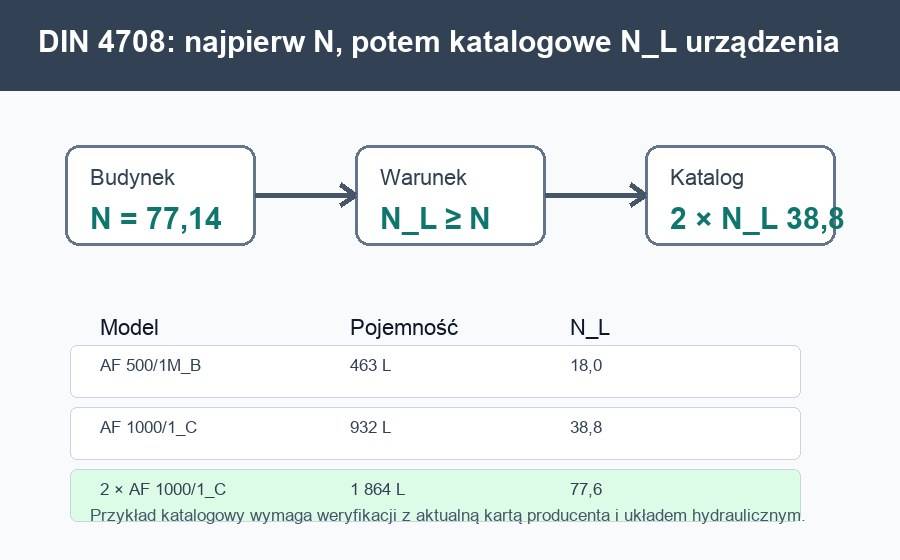
First calculate the required demand number:
Then do not convert it mechanically into litres. Select a unit or set whose catalogue N_L satisfies:
Catalogue example used by the calculator:
| Variant | N_L | Nominal capacity | Heat-exchange area |
|---|---|---|---|
| 1 × Reflex Storatherm Aqua AF 1000/1_C | 38.8 | 932 l | 4.48 m² |
| 2 × Reflex Storatherm Aqua AF 1000/1_C | 77.6 | 1,864 l | 8.96 m² |
The two-cylinder set satisfies the condition:
That is why a DIN-based result should not automatically become more than 4,000 l for this case. The 1,864 l value is the nominal capacity of a catalogue example that meets the performance condition. It is not a universal manufacturer recommendation and does not replace a detailed design.
Heat source check: why 40 kW matters
DIN 4708 leads to selection by N_L, but after selecting a cylinder the heat source still has to be checked. For 2 × 932 l, heating water from 10 °C to 55 °C stores approximately:
With a 40 kW heat source, the indicative recovery time is:
At 25 kW it would be about 3.9 h. This does not mean that 25 kW is always wrong, but in a 60-flat building it may be too low if the cylinder must recover quickly after a morning or evening peak. In the calculator, source power is therefore used for recovery and coil checks, not to artificially reduce the DIN cylinder size.
What about PN-EN 12831-3 and other methods?
For Polish projects, PN-EN 12831-3, the Technical Conditions and sanitary requirements still matter. PN-EN 12831-3 is relevant when describing DHW heat demand and usage characteristics, while the Technical Conditions require, among other things, 55–60 °C at draw-off points and disinfection capability.
There are also cases where DIN 4708 alone is not the right tool: hospitals, schools with showers, commercial kitchens, sports facilities and industrial buildings have their own draw-off profiles and sharp peaks. They need a separate balance of usage, operating hours and process demand. This article does not provide worked examples for those methods, because mixing them with DIN residential sizing often produces confusing and inflated results.
Common mistakes
- Converting N directly into litres. DIN 4708 requires comparison with catalogue N_L, not multiplication by a constant.
- Ignoring the manufacturer data sheet. N_L depends on the specific model, temperatures and loading power.
- Adding cylinders without checking hydraulics. Summing N_L is only a preliminary approximation if the loading and parallel operation are allowed.
- Undersized heat source. A cylinder may meet N_L, but recovery can still be too slow.
- Ignoring circulation and shock heating. Circulation losses and thermal disinfection affect daily energy and required power.
Summary
For residential buildings, hotels and dormitories, DHW cylinder sizing is clearest in the DIN 4708 flow: calculate required N, select a catalogue unit with N_L >= N, then check heat source output, recovery time, coil area and operating conditions.
The 60-flat example shows why a catalogue-based DIN selection may result in 2 × 932 l rather than a mechanical value above 4,000 l. Final selection always requires the current manufacturer data sheet and verification of the real hydraulic arrangement. For quick option checks, use the DHW cylinder sizing calculator.
Back to articles list