
Thermal Conductivity λ of Building Materials — Reference Tables
23 marca 2026 | Architecture
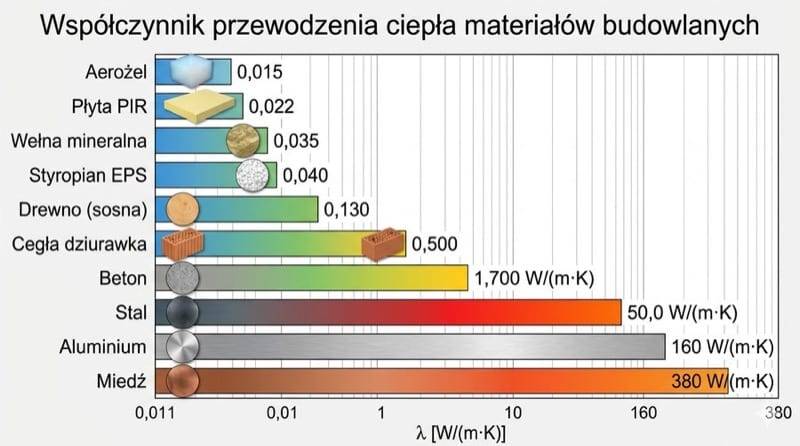
When calculating the U-value (thermal transmittance), the key parameter for each material is its thermal conductivity λ (lambda). The lower the λ, the better the insulating properties — expanded polystyrene retains heat far more effectively than concrete precisely because its λ is many times lower. The tables below contain λ values for the most common building materials, compliant with EN ISO 10456 and manufacturers' declarations of performance (DoP). To calculate the U-value of your building element using these values, use our thermal transmittance calculator.
Thermal Insulation Materials
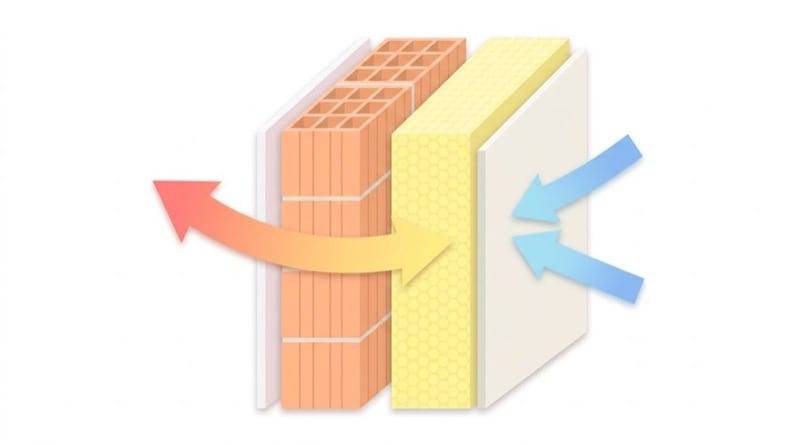
Thermal insulation materials are the foundation of any well-insulated building element. Their λ is many times lower than structural materials, so even a thin layer of insulation drastically reduces heat loss.
| Material | λ [W/(m·K)] | Density [kg/m³] | Notes |
|---|---|---|---|
EPS polystyrene (standard) | 0.036–0.040 | 15–25 | Facades, floors — most common |
EPS graphite polystyrene (Neopor) | 0.030–0.033 | 15–25 | Better insulation at the same thickness |
XPS polystyrene | 0.025–0.035 | 25–45 | Foundations, ground floors — moisture resistant |
Glass mineral wool | 0.030–0.044 | 10–48 | Lofts, ceilings, timber frame walls |
Stone mineral wool | 0.033–0.045 | 30–200 | Walls, roofs — better fire resistance |
Polyurethane foam PUR (spray) | 0.022–0.028 | 30–60 | Roofs, irregular surfaces — seamless application |
PIR foam (boards) | 0.020–0.026 | 30–50 | Flat roofs — lowest λ of common insulations |
Phenolic foam | 0.019–0.025 | 30–60 | Industrial buildings, pipe insulation |
Cellulose (loose fill / mat) | 0.038–0.042 | 25–60 | Lofts — recycled paper material |
Wood fibre board | 0.038–0.050 | 50–270 | Ecological construction — good thermal mass |
Natural cork board | 0.040–0.050 | 80–200 | Ecological alternative — thermal mass |
Perlite (loose granulate) | 0.045–0.060 | 60–120 | Glass block cavities, tank insulation |
Important: The λ values above are ranges for typical market products. For design calculations, always use the declared λD value from the specific product's Declaration of Performance (DoP), not catalogue values.
Masonry Materials
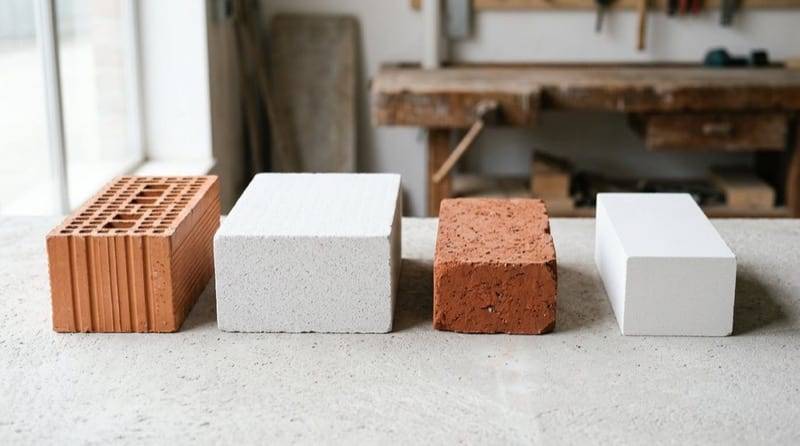
Masonry forms the structural layer of a building element. Its λ is much higher than insulation, so masonry alone cannot provide adequate thermal performance — an insulation layer is always required.
| Material | λ [W/(m·K)] | Density [kg/m³] | Notes |
|---|---|---|---|
Solid ceramic brick | 0.77 | 1,800 | Traditional construction, old buildings |
Perforated ceramic brick | 0.50–0.56 | 1,200–1,500 | Slightly better insulation due to holes |
Hollow clay block (e.g. Porotherm 25) | 0.22–0.30 | 700–900 | Most common wall in single-family housing |
Porotherm Profi (porised clay) | 0.10–0.14 | 550–700 | Premium range — requires less external insulation |
Calcium silicate block | 0.70–0.90 | 1,600–2,000 | Good thermal mass, requires good insulation |
Autoclaved aerated concrete (AAC) class 400 | 0.12–0.15 | 350–450 | Popular alternative — good wall insulation |
Autoclaved aerated concrete (AAC) class 600 | 0.17–0.21 | 550–650 | Higher strength, slightly worse U |
Lightweight aggregate concrete | 0.40–0.85 | 800–1,400 | Lighter than regular concrete, floors, lintels |
Concrete, Mortars and Renders
| Material | λ [W/(m·K)] | Density [kg/m³] |
|---|---|---|
Normal concrete (C20/25) | 1.70 | 2,400 |
Reinforced concrete | 2.00–2.50 | 2,400–2,500 |
Screed / cement floor levelling | 1.40–1.60 | 1,800–2,000 |
Cement mortar | 1.40 | 2,000 |
Cement-lime mortar | 0.80 | 1,800 |
Cement-lime render | 0.80 | 1,800 |
Gypsum plaster | 0.57 | 1,200 |
Acrylic / silicone thin-coat render | 0.70 | 1,500 |
Wood and Wood-Based Materials
Wood has surprisingly good thermal insulation properties compared to concrete or steel — its λ is more than 10 times lower than concrete. That is why timber construction can achieve low U-values with relatively thin elements.
| Material | λ [W/(m·K)] | Density [kg/m³] |
|---|---|---|
Softwood (pine, spruce) | 0.13 | 500–600 |
Hardwood (oak, beech) | 0.18–0.21 | 650–800 |
Plywood | 0.14–0.17 | 500–700 |
OSB board | 0.13 | 600–680 |
HDF hardboard | 0.10–0.18 | 800–1,100 |
Plasterboard (GK) | 0.25 | 900–1,000 |
Glass fibre reinforced gypsum board (GF) | 0.32 | 1,150 |
Fill Materials and Ground
| Material | λ [W/(m·K)] | Density [kg/m³] |
|---|---|---|
Expanded clay (loose) | 0.10–0.18 | 200–600 |
Expanded perlite (loose) | 0.045–0.060 | 60–120 |
Dry sand | 0.30–0.50 | 1,400–1,700 |
Dry gravel | 0.70–1.80 | 1,600–2,000 |
Soil / ground | 1.00–2.50 | 1,500–2,100 |
Other Building Materials
| Material | λ [W/(m·K)] | Notes |
|---|---|---|
Steel | 50 | Strong thermal bridge — reinforcement, profiles |
Aluminium | 160 | Window frames, facade profiles — thermal break required |
Float glass | 1.00 | Single pane — windows calculated separately (Ug) |
Bituminous felt / membrane | 0.23 | Roof waterproofing — thin layer, small contribution to R |
Still air (closed cavities) | 0.025 | Basis of how all porous insulation works |
How to Use the λ Tables for U-Value Calculations
The thermal resistance of a single material layer is calculated using the formula:
Where d is the layer thickness in metres and λ is the thermal conductivity in W/(m·K). The lower the λ and the thicker the layer, the higher the thermal resistance R — meaning better insulation.
Example: A layer of graphite EPS (λ = 0.031 W/(m·K)) with a thickness of 15 cm (0.15 m) has a thermal resistance:
R = 0.15 / 0.031 = 4.84 m²·K/W
This is equivalent to normal concrete of thickness: d = 4.84 × 1.70 = 8.2 metres — which is why insulation is so essential.
The total U-value of a building element is 1 divided by the sum of all resistances (layers plus surface resistances). Instead of calculating this manually, use the U-value calculator, which automatically sums the resistances and checks compliance with Polish building regulations.
Why Do Catalogue λ Values Differ from the Standard?
Many people notice discrepancies between λ values in EN ISO 10456 and those in manufacturers' technical data sheets. This is normal — the standard gives reference values for typical conditions (10°C, equilibrium moisture content), while actual λ depends on:
- Temperature — λ increases at higher temperatures (a few percent for some materials)
- Moisture — wet insulation conducts heat much better than dry. Mineral wool saturated with water can have λ 3–5 times higher than dry
- Density and product grade — EPS 100 has different λ than EPS 70
For design calculations and formal submissions (building permit, energy audit), always use the declared λD value from the product's Declaration of Performance (DoP). The values in the tables above are for quick estimates and typical calculations.
Summary
Knowledge of λ values for building materials is the foundation of any thermal calculation for a building element. Insulation materials have λ in the range 0.019–0.060 W/(m·K), while concrete and steel have 1.7 and 50 W/(m·K) respectively. This difference of hundreds of times explains why a few centimetres of polystyrene can "replace" a several-metre concrete wall in terms of insulating performance.
To calculate the U-value of a specific building element using the above data, go to the thermal transmittance calculator — simply enter the thickness and λ of each layer and the calculator will compute U and check compliance with current Polish regulations.
Back to articles list