
Pressure Drop Calculations in Medium and High Pressure Gas Pipelines
1 lutego 2026 | Gas
Calculating pressure drop in medium and elevated pressure gas pipelines (0.1-16 bar) requires the application of appropriate formulas that account for gas compressibility. In this article, we compare different calculation methods used worldwide and show how the Polish standard PN-76/M-34034 results compare to American methods (Weymouth, Panhandle, AGA).
If you need to quickly calculate pressure drop in a gas pipeline, use our medium and high pressure gas pipeline calculator.
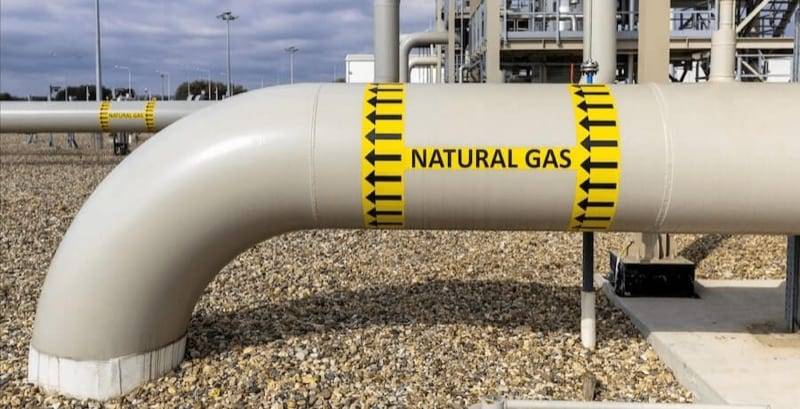
Introduction to Gas Pipeline Calculations
Gas flow in pipelines differs fundamentally from liquid flow. As a compressible medium, gas changes its density and velocity along the pipeline as pressure drops. This phenomenon requires more complex equations than the classical Darcy-Weisbach equation for incompressible flows.
When designing medium pressure gas pipelines, the following must be considered:
- Inlet pressure (P₁) - pressure at the pipeline entrance
- Volumetric flow rate (Q) - at normal or standard conditions
- Internal pipe diameter (D) - in mm or inches
- Pipeline length (L) - in meters or miles
- Relative gas density (d) - ratio of gas density to air density
- Flow temperature (T) - affects viscosity and gas density
- Pipe roughness (k) - depends on material and surface condition
PN-76/M-34034 Method (Polish Standard)
The Polish standard PN-76/M-34034 is based on the general isothermal equation for compressible gas flow. The method uses the Darcy-Weisbach equation for pressure loss calculations and the Colebrook-White equation for determining the friction factor λ. Below is the complete calculation algorithm.
Step 1: Input Data Preparation
Before starting calculations, all quantities must be converted to appropriate units:
- Absolute pressure - gauge pressure plus atmospheric pressure:
- Absolute temperature in Kelvin:
- Relative roughness - ratio of absolute roughness to diameter:
Step 2: Individual Gas Constant
The gas constant for a specific gas is calculated based on its relative density (ratio of gas density to air density):
Where:
- Ru = 8314.46 J/(kmol·K) - universal gas constant
- Mair = 28.97 kg/kmol - molar mass of air
- d - relative gas density [-]
For high-methane natural gas (d = 0.6), the gas constant is approximately 480 J/(kg·K).
Step 3: Gas Velocity at Inlet
The gas velocity at the inlet point is calculated from the continuity equation, converting flow from normal conditions (Pn = 101325 Pa, Tn = 273.15 K) to actual conditions:
Where:
- Qn - volumetric flow rate at normal conditions [m³/s]
- A - pipe cross-sectional area [m²]
- P1 - absolute pressure at inlet [Pa]
- T - flow temperature [K]
Step 4: Kinematic Viscosity
The kinematic viscosity of gas depends on pressure and temperature. It is calculated from dynamic viscosity and gas density at flow conditions:
Where gas density at flow conditions:
With air density at normal conditions ρn = 1.293 kg/m³.
Step 5: Reynolds Number
The Reynolds number determines the flow regime:
Where D is the internal pipe diameter in meters.
Step 6: Friction Factor λ
The choice of friction factor formula depends on the Reynolds number:
Laminar flow (Re ≤ 2300):
Transitional flow (2300 < Re ≤ 4000):
Turbulent flow (Re > 4000) - Colebrook-White equation (solved iteratively):
The Colebrook-White equation is implicit - λ appears on both sides. It is solved iteratively (e.g., Newton-Raphson method), starting from an initial value of λ = 0.02.
Step 7: Gas Velocity at Outlet (Iterative)
A key element of the PN-76 method is accounting for gas velocity changes along the pipeline. As pressure drops, the gas expands and accelerates. The outlet velocity w₂ is calculated from the isothermal equation:
Where:
- R - individual gas constant [J/(kg·K)]
- T - temperature [K]
- L - pipeline length [m]
- D - diameter [m]
This equation is also solved iteratively using the Newton-Raphson method, finding w₂ > w₁.
Step 8: Pressure Drop Calculation
Knowing the inlet and outlet velocities, the pressure drop is calculated from:
Final pressure:
Algorithm Summary
The PN-76 method is the most physically accurate because it:
- Accounts for gas density changes along the pipeline
- Calculates the actual velocity increase from w₁ to w₂
- Uses the accurate Colebrook-White equation for friction factor
- Uses normal conditions as the reference point for flow
The disadvantage of the method is the need to solve two iterative equations (Colebrook-White and isothermal equation), which requires computational calculations.
Weymouth Method (1912)
The oldest and most widespread empirical method developed by T.R. Weymouth. Formula in US customary units:
Where:
- Q - flow rate [SCFD]
- Tb, Pb - base temperature and pressure
- E - efficiency factor (0.85-1.0)
- S - relative gas density
- Z - compressibility factor
The Weymouth method is considered conservative - it gives higher pressure drops than other methods.
Panhandle A Method (1940s)
Developed for US transmission pipelines, suitable for partially turbulent flows (Re 2000-3000):
Panhandle B Method (1956)
Modified version for fully turbulent flow, gives the lowest pressure drops:
AGA Method (American Gas Association)
Uses the general equation with friction factor calculated by the Colebrook-White method:
Where f is the Darcy friction factor calculated iteratively from the Colebrook-White equation.
Results Comparison - Practical Analysis
We conducted a detailed comparison of results for three typical design cases. All calculations were performed for high-methane natural gas (type E) with a relative density of 0.6.
Test Cases
| Test | Flow Rate | Diameter | Length | Pressure | Temperature |
|---|---|---|---|---|---|
| 1 | 300 m³/h | DN 54.5 mm | 200 m | 5 bar | 15°C |
| 2 | 100 m³/h | DN 50 mm | 100 m | 5 bar | 15°C |
| 3 | 1000 m³/h | DN 100 mm | 1000 m | 10 bar | 15°C |
Pressure Drop Results
| Method | Test 1 [bar] | Test 2 [bar] | Test 3 [bar] |
|---|---|---|---|
| PN-76/M-34034 | 0.0786 | 0.0073 | 0.0982 |
| General Isothermal | 0.0787 | 0.0073 | 0.0982 |
| Weymouth | 0.0856 | 0.0075 | 0.1016 |
| AGA | 0.0706 | 0.0066 | 0.0882 |
| Panhandle A | 0.0512 | 0.0050 | 0.0683 |
| Panhandle B | 0.0317 | 0.0028 | 0.0451 |
Percentage Differences vs PN-76
| Method | Test 1 | Test 2 | Test 3 | Average |
|---|---|---|---|---|
| General Isothermal | +0.1% | +0.2% | 0.0% | +0.1% |
| Weymouth | +8.9% | +2.4% | +3.5% | +4.9% |
| AGA | -10.2% | -10.0% | -10.2% | -10.1% |
| Panhandle A | -34.9% | -30.9% | -30.5% | -32.1% |
| Panhandle B | -59.7% | -61.5% | -54.1% | -58.4% |
Interpretation of Results
The PN-76/M-34034 method shows virtually perfect agreement (difference < 0.2%) with the general isothermal gas flow equation. This is the most physically accurate method, which accounts for gas expansion along the pipeline and calculates velocity change from w₁ to w₂.
Conservatism Hierarchy of Methods
From most to least conservative:
- Weymouth (+5-9% vs PN-76) - gives the highest pressure drops
- PN-76 / Isothermal (baseline) - most physically accurate
- AGA (-10% vs PN-76) - modern method with Colebrook-White
- Panhandle A (-30-35% vs PN-76) - for partial turbulence
- Panhandle B (-55-60% vs PN-76) - for full turbulence
Why Such Differences?
Differences between methods result from:
- Empirical simplifications - Panhandle A/B omit the explicit friction factor, replacing it with empirical constants
- Efficiency factor E - American methods use E = 0.85-0.92 to account for real pipeline imperfections
- Base conditions - different standard temperatures (15°C vs 60°F = 15.56°C)
- Applicability range - each method was optimized for specific flow conditions
Practical Recommendations
When to Use Which Method?
| Application | Recommended Method | Justification |
|---|---|---|
| Projects in Poland | PN-76/M-34034 | National standard compliance |
| US transmission pipelines | Panhandle B | Industry standard |
| Preliminary calculations | Weymouth | Conservative, safe |
| Detailed analyses | AGA or Isothermal | Physically justified |
| Low Re (< 3000) | Panhandle A | Optimized for this range |
Safety Margin
When designing gas pipelines, it is recommended to:
- Use conservative methods (Weymouth, PN-76) for safety
- Verify results with at least two methods
- Include a 10-20% safety factor for uncertainties
Summary
The PN-76/M-34034 method used in Polish standards is a solid, physically justified calculation method. Results are virtually identical to the general isothermal equation and fall within a reasonable range compared to recognized international methods.
When choosing a calculation method, consider regulatory requirements of the given country, flow characteristics (Reynolds number), required level of conservatism, and availability of input data.
The gas pipeline sizing calculator in our application uses the PN-76/M-34034 method, ensuring compliance with Polish design standards.
References and Sources
- PN-76/M-34034 - Principles for calculating pressure losses in gas or liquid flow in pipelines
- GPSA Engineering Data Book - Gas Processors Suppliers Association
- Menon, E.S. - "Gas Pipeline Hydraulics"
- Bąkowski K. - "Gas networks and installations"