
Dew Point and Condensation in Building Partitions - Guide
18 stycznia 2026 | Heating
Moisture in building partitions is one of the most serious problems in modern construction. It can lead to mold growth, degradation of insulation materials, and significant deterioration of thermal comfort. The key to preventing these problems is understanding the condensation phenomenon and proper partition design.
If you need to quickly check the condensation risk in your partition, use our partition condensation calculator.
What is the Dew Point?
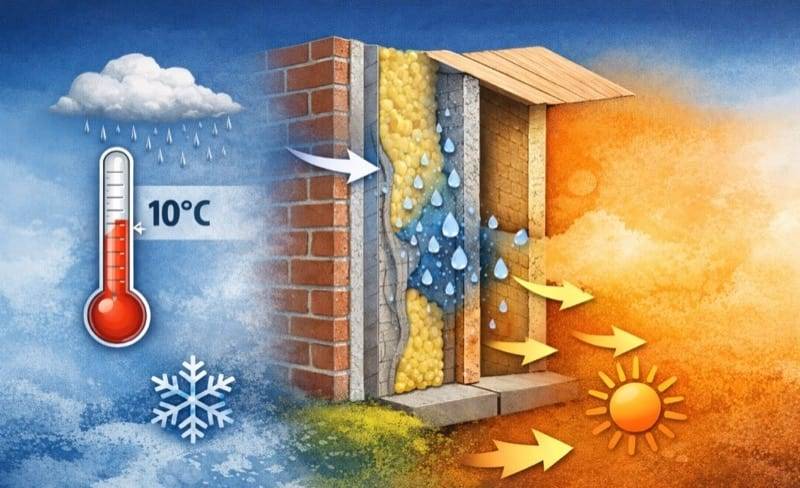
The dew point (dew temperature) is the temperature at which air with a specific relative humidity becomes saturated with water vapor. When a surface temperature drops below the dew point, water vapor begins to condense - we observe this as "dew" or fog.
In buildings, this phenomenon is particularly important. In winter, when the internal surface temperature of a partition (wall, window, roof) drops below the dew point of the room air, condensed water will appear on that surface. This is an ideal environment for fungi and mold growth.
The dew point can be calculated using the Magnus-Tetens formula:
where:
- γ = ln(RH/100) + (a × T)/(b + T)
- a = 17.625, b = 243.04
- RH - relative humidity [%]
- T - air temperature [°C]
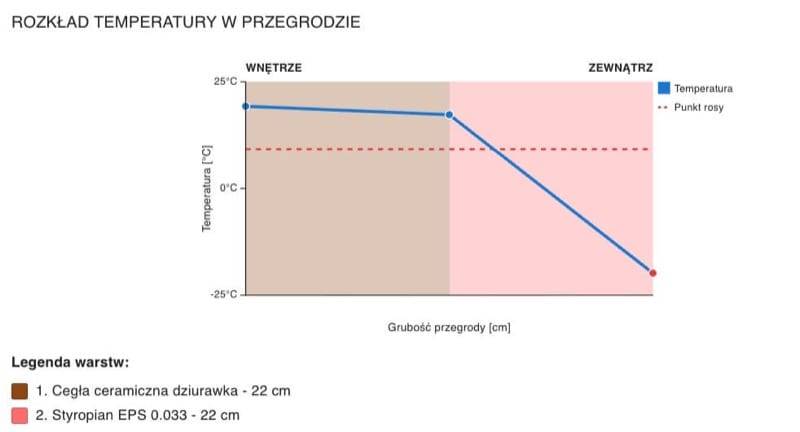
For typical conditions in a residential room (20°C, 50% humidity), the dew point is approximately 9.3°C. This means that if any surface in the room has a temperature lower than 9.3°C, condensation will occur on it.
Temperature Factor fRsi
The fRsi coefficient (temperature factor at internal surface) is a dimensionless indicator determining the risk of condensation on the internal surface of a partition. It is a key parameter in the hygrothermal assessment of buildings.
where:
- Rt - thermal resistance of partition material layers [m²K/W]
- Rsi = 0.13 m²K/W - heat transfer resistance at internal surface
- Rse = 0.04 m²K/W - heat transfer resistance at external surface
The interpretation of the fRsi coefficient is simple - the higher the value, the higher the internal surface temperature of the partition will be, and thus the lower the risk of condensation.
Legal Requirements in Poland
According to Technical Requirements 2021 (Regulation of the Minister of Infrastructure), building partitions in rooms heated to a minimum temperature of 20°C must meet:
Minimum fRsi coefficient | ≥ 0.72 |
|---|---|
Design internal temperature | 20°C |
Design internal humidity | 50% |
The requirement fRsi ≥ 0.72 with the assumed internal conditions (20°C, 50%) and external conditions (-20°C for the Polish climate zone) ensures that the internal surface temperature does not drop below the critical temperature for mold growth.
Types of Condensation in Partitions
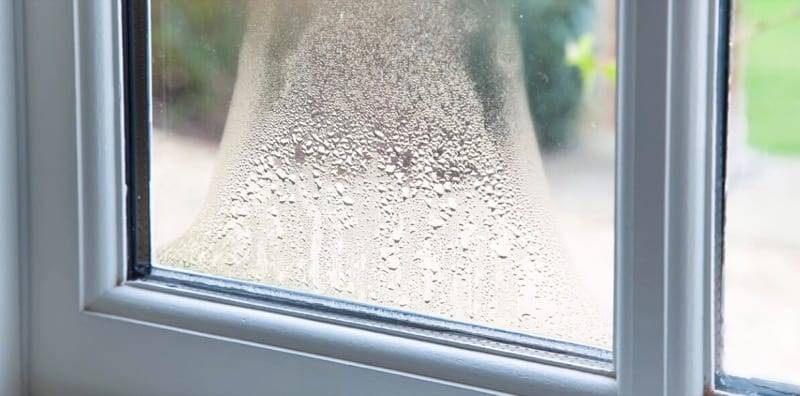
Surface condensation occurs on the internal surface of the partition when its temperature drops below the dew point. It manifests as:
- water condensation on the surface
- dampening and darkening of plaster
- mold and fungus growth
- paint peeling
This is the most visible type of condensation and relatively easy to diagnose.
Interstitial condensation occurs inside the partition when water vapor passing through materials encounters layers with a temperature lower than the dew point. It is much more dangerous because:
- it is difficult to detect
- it can lead to degradation of thermal insulation
- it causes corrosion of steel elements
- it can continue for years without visible symptoms
Glaser Method - Interstitial Condensation Analysis
The Glaser method (described in PN-EN ISO 13788) allows for the analysis of condensation risk inside a multilayer partition. It involves comparing the distribution of actual water vapor pressure with the saturation pressure distribution.
Saturation water vapor pressure depends on temperature and can be calculated from the formula:
for T ≥ 0°C
for T < 0°C
Condensation occurs where the actual water vapor pressure exceeds the saturation pressure. In practice, this means that water vapor encounters layers too cold for it to pass through in a gaseous state.
Practical Examples
Example 1: Wall meeting requirements
Typical three-layer wall from the inside:
- Gypsum plaster 1.5 cm (λ = 0.39 W/mK)
- Ceramic block 25 cm (λ = 0.25 W/mK)
- EPS styrofoam 15 cm (λ = 0.035 W/mK)
- External plaster 1.5 cm (λ = 0.82 W/mK)
For this wall, the fRsi coefficient is approximately 0.94 - well above the required 0.72. The internal surface temperature at design conditions (20°C inside, -20°C outside) will be approximately 17.6°C, well above the dew point (9.3°C).
Example 2: Problematic thermal bridge
Uninsulated reinforced concrete column in external wall:
- Reinforced concrete 25 cm (λ = 2.3 W/mK)
- No insulation
For such an element, fRsi is only about 0.58 - well below requirements. The surface temperature can drop to 2°C, causing strong condensation.
Solution: Insulating the column from the outside with minimum 5 cm of styrofoam raises fRsi above 0.72.
How to Prevent Condensation?
1. Ensuring thermal insulation continuity
Thermal bridges are the main cause of surface condensation. The following should be eliminated:
- uninsulated ring beams and lintels
- wall-to-balcony connections
- building corners
- areas around windows and doors
2. Proper layer arrangement
The rule: materials with high diffusion resistance (e.g., vapor barrier film) should be placed on the warm side of the partition, and vapor-permeable materials on the cold side.
3. Proper ventilation
Too high indoor air humidity (above 60%) drastically increases the risk of condensation. Air exchange according to standards must be ensured.
4. Adequate insulation thickness
For the Polish climate, minimum insulation thicknesses for walls are:
- EPS styrofoam λ=0.035: minimum 14-15 cm
- Mineral wool λ=0.035: minimum 14-15 cm
- PIR λ=0.022: minimum 9-10 cm
Standards and Regulations
PN-EN ISO 13788:2013 - Hygrothermal performance of building components and building elements. Internal surface temperature to avoid critical surface humidity and interstitial condensation.
PN-EN ISO 6946 - Building components and building elements. Thermal resistance and thermal transmittance. Calculation method.
Technical Requirements 2021 - Regulation of the Minister of Infrastructure on technical requirements for buildings and their location.
Summary
Proper condensation risk analysis is an essential element of building partition design. Key parameters are the fRsi coefficient (minimum 0.72 according to WT 2021) and the distribution of temperatures and water vapor pressures in the partition.
To quickly check your partition parameters, use our partition condensation calculator, which automatically calculates all necessary parameters and checks compliance with Polish regulations.
Back to articles list