
Recuperation vs. natural ventilation - what to choose when building a house?
11 kwietnia 2026 | Ventilation
Ventilation is one of the key elements of every building - it affects comfort, residents' health and operating costs. In single-family houses, two main solutions are used: traditional natural ventilation and mechanical ventilation with heat recovery, known as recuperation. The choice between them is a decision for many years, so it is worth comparing them reliably - both technically and economically.
If you want to check exactly how much you will save thanks to recuperation, use our heat recovery calculator.
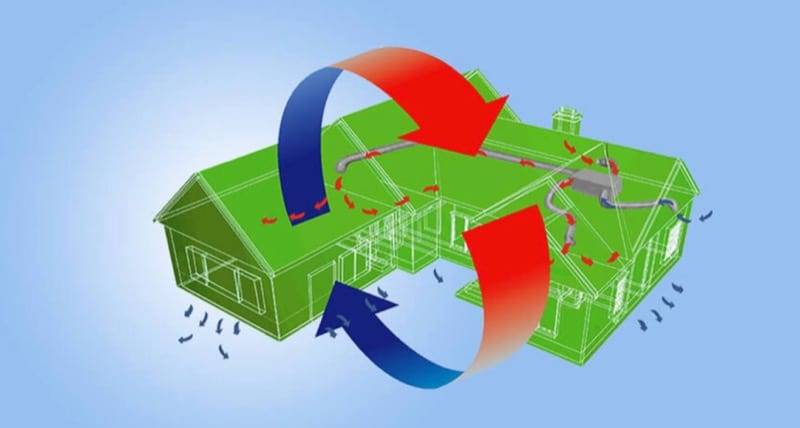
How does natural ventilation work?
Natural ventilation uses the natural difference in air density. Warm air from the interior rises and escapes through exhaust ducts (usually in the kitchen, bathroom and WC). Fresh air flows in through gaps in windows, window vents or wall vents - often humidity-controlled.
The driving force is the chimney draft, which depends on:
- the temperature difference between the interior and the surroundings,
- the height of the ventilation chimney,
- weather conditions (wind, pressure).
On warm, windless days the draft practically disappears - in summer natural ventilation is often insufficient, and in winter difficult to control (excessive heat loss).
How does recuperation work?
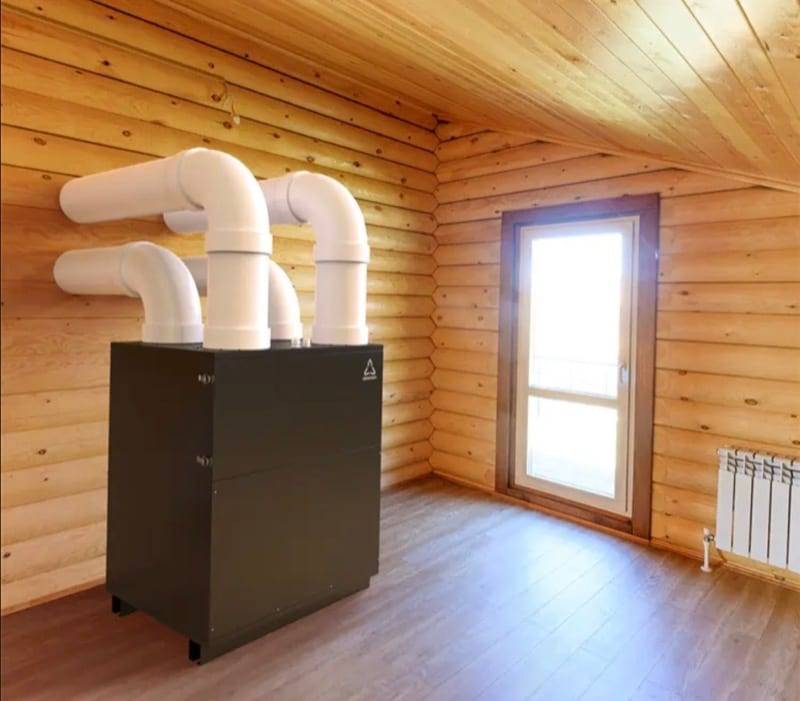
Recuperation (mechanical ventilation with heat recovery) is a system in which air is exchanged by a pair of fans - supply and exhaust. The heart of the system is the recuperator containing a heat exchanger, in which the stream of warm exhaust air heats the cold supply air from outside without mixing.
Typical components of the installation:
- ventilation unit with a heat exchanger and fans,
- air intake (from outside) and exhaust outlet,
- supply ducts (to rooms, bedrooms, living room) and exhaust ducts (kitchen, bathrooms, WC, wardrobes),
- anemostats and ceiling diffusers,
- air filters (typically ISO Coarse / G4 as a pre-filter; on supply a finer filter is recommended, e.g. ISO ePM1 55-60%, roughly the former F7 class - especially in heavily polluted areas).
Types of heat exchangers in recuperators
The efficiency and comfort of a recuperator depend primarily on the type of heat exchanger:
| Exchanger type | Temperature efficiency | Notes |
|---|---|---|
| Cross-flow | 50-70% | Cheap, simple, lower efficiency |
| Counter-flow | 85-95% | Most popular in single-family houses |
| Rotary | 75-85% | Also recovers moisture, has moving parts |
| Enthalpy (membrane) | 80-90% | Recovers heat and moisture, reduces condensation and freezing risk |
The selection of ventilation duct diameters is available in our ventilation duct sizing calculator.
Legal requirements and standards (Poland)
In Poland, ventilation in residential buildings is regulated by:
- Technical Conditions (regulation on the technical conditions to be met by buildings and their location) - require ventilation in every residential room,
- PN-B-03430:1983 with amendment Az3:2000 - a standard formally withdrawn by the Polish Committee for Standardization in 2015 but still referenced in Technical Conditions. It specifies minimum exhaust airflows:
- kitchen with a gas or coal stove: 70 m³/h,
- kitchen with an electric stove in an apartment for up to 3 people: 30 m³/h,
- kitchen with an electric stove for more than 3 people, or a windowless kitchen / kitchenette with an electric stove: 50 m³/h,
- bathroom (with or without WC): 50 m³/h,
- separate WC: 30 m³/h,
- windowless room (e.g., wardrobe): 15 m³/h,
- a room separated from "wet" rooms by more than two doors or on an upper floor of a multi-level house: an additional 30 m³/h.
These values must be met regardless of the chosen ventilation system. Current Technical Conditions (since 2021 - EP ≤ 70 kWh/(m²·year) for a single-family house) significantly limit the allowable EP index. In practice, recuperation greatly facilitates meeting it and is usually the most reasonable design choice; without it, the designer must compensate with better insulation, a heat pump or photovoltaics.
Advantages of recuperation
- Energy savings: heat recovery from exhaust air can reduce heating demand by 25-40% compared to natural ventilation (estimates from the Building Research Institute and experience of energy-efficient house designers).
- Better air quality: filters (typically ISO Coarse / G4 on exhaust and ISO ePM1 55-60% on supply, roughly the former F7) capture PM10, PM2.5, pollen and fungal spores. An ePM1 55% filter captures at least 55% of PM1 dust and typically 65-80% of PM2.5 in a single pass.
- Constant, controlled supply of fresh air: independent of weather, wind and outside temperature.
- Prevention of dampness and mold: controlled exhaust from kitchens, bathrooms and WCs quickly removes excess moisture.
- Acoustic comfort: a well-designed system with silencers operates below 25-30 dB(A) in the bedroom.
- No drafts: no cold air streams from window vents.
Disadvantages of recuperation
- Higher installation cost: for a single-family house of approx. 150 m², the cost of a complete installation (mid-range central unit + ducts + assembly + commissioning) is roughly in the range of PLN 18,000-35,000, depending on the class of the device and the complexity of the system.
- Maintenance requirements: filter replacement 2-4 times a year (filter cost PLN 120-300/set), periodic duct cleaning (every 3-5 years).
- Electricity consumption: EC fans consume approx. 30-80 W in continuous operation, which over 24/7 equals 260-700 kWh per year.
- Space for the unit and ducts: must be planned at the design stage of the house (technical room, space in suspended ceilings or in the attic).
- Sensitivity to design and installation errors: an unbalanced system, too small duct cross-sections or lack of silencers reduce comfort and efficiency.
Advantages of natural ventilation
- Low installation cost: mainly involves building chimneys and installing grilles and vents.
- No electricity consumption and no dependence on active devices.
- Simple construction: less prone to failure, no regular fan maintenance.
- Quiet operation: no fan noise.
Disadvantages of natural ventilation
- Large heat losses: no recovery - in winter, heated air escapes from the building, significantly raising heating bills.
- Variable efficiency: on warm, windless days the draft almost disappears; in winter it can be too intense.
- No filtration: air enters the house as polluted as it is outside (dust, pollen, smog).
- Risk of dampness and mold: with insufficient draft, moisture lingers in bathrooms and the kitchen.
- Risk of reverse flow: in very tight buildings, exhaust may reverse (inflow through the chimney), which is dangerous with open-combustion fireplaces or boilers.
- Problems meeting the required EP index in energy-efficient houses.
Cost comparison - example
Let us assume a single-family house of 150 m² built in accordance with Polish Technical Conditions 2021, with a seasonal heating demand of approx. 9,000-12,000 kWh/year. In the natural ventilation variant, ventilation accounts for a significant share of thermal losses. A counter-flow recuperator with 85% temperature efficiency reduces ventilation losses by approx. 2,500-4,000 kWh of thermal energy per year. Note: this is thermal energy savings, not directly electrical - to convert it into cost, the heat source must be taken into account:
- natural gas (boiler efficiency approx. 95%, price approx. PLN 0.35/kWh): gross savings approx. PLN 920-1,470/year,
- heat pump (SCOP approx. 3.5, electricity price approx. PLN 0.90/kWh): gross savings approx. PLN 640-1,030/year,
- pellet boiler (efficiency 85%, fuel price approx. PLN 0.30/kWh equivalent): gross savings approx. PLN 880-1,410/year.
From this, the cost of fan electricity (260-700 kWh/year × approx. PLN 0.90 = PLN 235-630) and the cost of filters (PLN 250-600/year) must be subtracted.
| Item | Natural ventilation | Recuperation |
|---|---|---|
| Installation cost | PLN 2,000-5,000 | PLN 18,000-35,000 |
| Annual filter cost | PLN 0 | PLN 250-600 |
| Annual fan electricity cost | PLN 0 | PLN 235-630 |
| Annual gross heating savings (gas/heat pump/pellet) | - | PLN 640-1,470 |
| Net annual balance | - | approx. PLN 0-700 benefit (highly dependent on heat source) |
Conclusion: the economic argument alone is rarely enough to justify recuperation - the simple payback period from energy savings only can be long (20-30 years, sometimes more). Recuperation is chosen primarily for comfort, air quality and to meet Technical Conditions 2021 requirements. The tighter the house, the more expensive the energy and the higher the recuperator efficiency - the better the financial balance.
Recuperation and air quality
One of the key advantages of recuperation is filtration of the supplied air. Modern filters retain:
- Particulate matter PM10 and PM2.5 - an ISO ePM1 55% filter (roughly former F7 class) captures approx. 65-80% of PM2.5 in a single pass. With continuous air exchange, indoor dust concentration drops several times compared to outside.
- Allergens: plant pollen, fungal spores, pet hair.
- Odors from outside: exhaust fumes, smoke, emissions from industrial plants (when carbon filters are used).
This is particularly important in regions with high air pollution (Lesser Poland, Silesia), where winter PM2.5 concentrations regularly exceed WHO limits.
Recuperation and energy efficiency
The more energy-efficient the house, the greater the share of ventilation losses in total heat losses. In houses built in line with Technical Conditions 2021, transmission losses (walls, windows, roof) are small, while ventilation losses can account for 40-50% of total losses. Hence a simple rule: the newer and tighter the house, the greater the economic sense of recuperation.
Good practice: when designing a "heat pump + photovoltaics" set, recuperation is almost mandatory - without it, the heat pump will be oversized and the PV effect weakened.
Hybrid ventilation - a compromise
If the budget does not allow for recuperation, an alternative is hybrid ventilation - natural ventilation assisted by exhaust fans (fixed or triggered by humidity/CO₂ sensors) and humidity-controlled vents. It does not recover heat, but provides a more stable airflow than classic natural ventilation.
Frequently Asked Questions (FAQ)
Can recuperation be installed in an existing house? Yes, but it is more expensive and difficult - ducts must be routed in ceiling enclosures or along walls. Major renovations and roof replacement are often the best opportunity.
Does the recuperator dry the air in winter? The recuperator itself does not actively dry - the mechanism is that in winter we strongly ventilate the house with outside air of low absolute humidity. After heating, the relative humidity in the room drops (often to 25-35% RH). The solution is an enthalpy exchanger, which recovers some moisture from the exhaust air.
Can recuperation be combined with a fireplace? Yes, but only with a fireplace with a closed combustion chamber and dedicated outside air supply. An open fireplace + recuperation is a dangerous combination.
Does GWC (ground heat exchanger) make sense? Economically, a glycol GWC rarely pays off quickly - it raises installation cost by approx. PLN 8,000-15,000, and energy savings are moderate. However, it can make sense for summer comfort (pre-cooling air in heat waves) and reducing the work of the anti-freeze system in winter. The decision should take into account the type of ground, site access and earthwork costs.
Summary - what to choose?
Recuperation is definitely a more efficient, comfortable and modern solution. In houses built in accordance with the current Technical Conditions there is practically no sensible alternative if we care about reasonable heating costs and good air quality. Natural ventilation remains a reasonable choice only where the budget is very tight, the house is leaky (e.g., extension of an old building) or we do not plan to live there year-round.
Before making a decision, calculate the real savings for your house - use the heat recovery calculator and the ventilation duct sizing calculator.
Back to articles list