
Pipe diameter table for plumbing installations — steel, copper, PP, PEX, AluPEX
4 kwietnia 2026 | Pipes
Selecting the correct pipe diameter is the foundation of every plumbing installation project. In practice, the designer needs to know not only the nominal diameter but also the actual pipe dimensions — the outer diameter, wall thickness and inner diameter — as well as the weight of the pipe filled with water, which is needed for selecting supports and brackets.
If you want to quickly calculate the water volume in an installation, use our pipe capacity calculator.
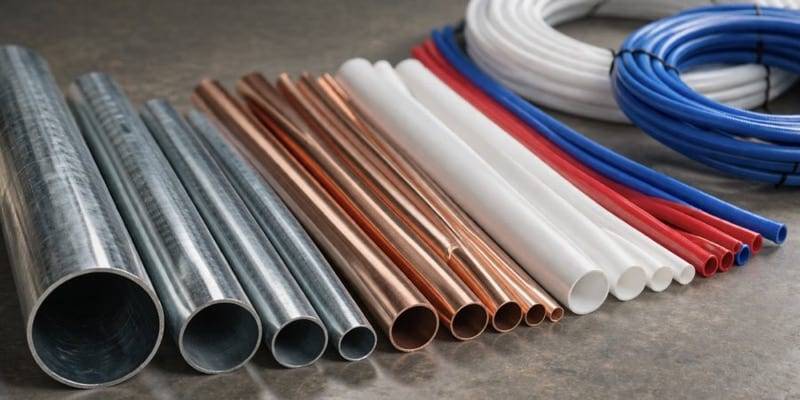
Pipe diameter designations
Two methods of pipe designation are used in internal installations:
- DN (nominal diameter) — applies to steel pipes. DN does not directly correspond to any geometric dimension of the pipe; it is a conventional designation approximately equal to the internal diameter.
- dext x s — applies to plastic pipes and copper. The designation gives the outer diameter and wall thickness in millimetres (e.g. 20x2,0 means a pipe with an outer diameter of 20 mm and a wall thickness of 2 mm).
The internal diameter determines the pipe's flow capacity and the water volume in the installation. Therefore, when comparing pipes made of different materials, you should always compare internal diameters — pipes with the same outer diameter may have completely different internal diameters due to different wall thicknesses.
How weight and capacity were calculated
The weight of an empty pipe was calculated using the formula:
Water capacity and the weight of the pipe filled with water:
Assumed material densities:
| Material | Density [kg/m³] |
|---|---|
| Steel | 7 850 |
| Copper | 8 900 |
| Polypropylene (PP) | 900 |
| Cross-linked polyethylene (PEX) | 940 |
| PEX-Al-PEX (catalogue data) | — |
| Water (20°C) | 998 |
The weight of multilayer PEX-Al-PEX pipes is given based on manufacturers' catalogue data, because their wall consists of layers with different densities (polyethylene + aluminium).
Steel pipes (PN-EN 10255)
Black and galvanised steel pipes used in central heating and gas installations. Designated by nominal diameter DN.
| Designation | dext [mm] | s [mm] | dint [mm] | Pipe weight [kg/m] | Water cap. [l/m] | With water [kg/m] |
|---|---|---|---|---|---|---|
| DN 15 | 21,3 | 2,0 | 17,3 | 0,95 | 0,235 | 1,19 |
| DN 20 | 26,9 | 2,3 | 22,3 | 1,40 | 0,391 | 1,79 |
| DN 25 | 33,7 | 2,6 | 28,5 | 1,99 | 0,638 | 2,63 |
| DN 32 | 42,4 | 2,6 | 37,2 | 2,55 | 1,087 | 3,64 |
| DN 40 | 48,3 | 2,6 | 43,1 | 2,93 | 1,459 | 4,39 |
| DN 50 | 60,3 | 2,9 | 54,5 | 4,11 | 2,333 | 6,43 |
| DN 65 | 76,1 | 2,9 | 70,3 | 5,24 | 3,882 | 9,11 |
| DN 80 | 88,9 | 3,2 | 82,5 | 6,76 | 5,346 | 12,10 |
| DN 100 | 114,3 | 3,6 | 107,1 | 9,83 | 9,009 | 18,82 |
| DN 125 | 139,7 | 4,0 | 131,7 | 13,39 | 13,623 | 26,98 |
| DN 150 | 168,3 | 4,5 | 159,3 | 18,18 | 19,931 | 38,07 |
Copper pipes (PN-EN 1057)
Copper pipes used in water supply, central heating and gas installations. Designated by outer diameter and wall thickness.
| Designation | dext [mm] | s [mm] | dint [mm] | Pipe weight [kg/m] | Water cap. [l/m] | With water [kg/m] |
|---|---|---|---|---|---|---|
| 8x1,0 | 8,0 | 1,0 | 6,0 | 0,20 | 0,028 | 0,22 |
| 12x1,0 | 12,0 | 1,0 | 10,0 | 0,31 | 0,079 | 0,39 |
| 15x1,0 | 15,0 | 1,0 | 13,0 | 0,39 | 0,133 | 0,52 |
| 18x1,0 | 18,0 | 1,0 | 16,0 | 0,48 | 0,201 | 0,68 |
| 22x1,5 | 22,0 | 1,5 | 19,0 | 0,86 | 0,284 | 1,14 |
| 28x1,5 | 28,0 | 1,5 | 25,0 | 1,11 | 0,491 | 1,60 |
| 35x1,5 | 35,0 | 1,5 | 32,0 | 1,40 | 0,804 | 2,21 |
| 42x1,5 | 42,0 | 1,5 | 39,0 | 1,70 | 1,195 | 2,89 |
| 54x2,0 | 54,0 | 2,0 | 50,0 | 2,91 | 1,963 | 4,87 |
| 64x2,0 | 64,0 | 2,0 | 60,0 | 3,47 | 2,827 | 6,29 |
| 76,1x2,0 | 76,1 | 2,0 | 72,1 | 4,14 | 4,083 | 8,22 |
| 88,9x2,0 | 88,9 | 2,0 | 84,9 | 4,86 | 5,661 | 10,51 |
| 108x2,5 | 108,0 | 2,5 | 103,0 | 7,37 | 8,332 | 15,69 |
Polypropylene pipes PP PN16 (PN-EN ISO 15874)
PP PN16 pipes designed for cold and hot water installations (up to 60°C). Thinner wall than PN20, larger internal diameter for the same outer diameter.
| Designation | dext [mm] | s [mm] | dint [mm] | Pipe weight [kg/m] | Water cap. [l/m] | With water [kg/m] |
|---|---|---|---|---|---|---|
| 16x2,2 | 16,0 | 2,2 | 11,6 | 0,09 | 0,106 | 0,19 |
| 20x2,8 | 20,0 | 2,8 | 14,4 | 0,14 | 0,163 | 0,30 |
| 25x3,5 | 25,0 | 3,5 | 18,0 | 0,21 | 0,254 | 0,47 |
| 32x4,4 | 32,0 | 4,4 | 23,2 | 0,34 | 0,423 | 0,77 |
| 40x5,5 | 40,0 | 5,5 | 29,0 | 0,54 | 0,661 | 1,20 |
| 50x6,9 | 50,0 | 6,9 | 36,2 | 0,84 | 1,029 | 1,87 |
| 63x8,6 | 63,0 | 8,6 | 45,8 | 1,32 | 1,647 | 2,97 |
| 75x10,3 | 75,0 | 10,3 | 54,4 | 1,88 | 2,324 | 4,20 |
| 90x12,3 | 90,0 | 12,3 | 65,4 | 2,70 | 3,359 | 6,05 |
| 110x15,1 | 110,0 | 15,1 | 79,8 | 4,05 | 5,001 | 9,04 |
Polypropylene pipes PP PN20 (PN-EN ISO 15874)
PP PN20 pipes designed for domestic hot water and central heating installations (up to 80°C). Thicker wall provides higher pressure resistance at elevated temperatures.
| Designation | dext [mm] | s [mm] | dint [mm] | Pipe weight [kg/m] | Water cap. [l/m] | With water [kg/m] |
|---|---|---|---|---|---|---|
| 16x2,7 | 16,0 | 2,7 | 10,6 | 0,10 | 0,088 | 0,19 |
| 20x3,4 | 20,0 | 3,4 | 13,2 | 0,16 | 0,137 | 0,30 |
| 25x4,2 | 25,0 | 4,2 | 16,6 | 0,25 | 0,216 | 0,46 |
| 32x5,4 | 32,0 | 5,4 | 21,2 | 0,41 | 0,353 | 0,76 |
| 40x6,7 | 40,0 | 6,7 | 26,6 | 0,63 | 0,556 | 1,19 |
| 50x8,3 | 50,0 | 8,3 | 33,4 | 0,98 | 0,876 | 1,85 |
| 63x10,5 | 63,0 | 10,5 | 42,0 | 1,56 | 1,385 | 2,94 |
| 75x12,5 | 75,0 | 12,5 | 50,0 | 2,21 | 1,963 | 4,17 |
| 90x15,0 | 90,0 | 15,0 | 60,0 | 3,18 | 2,827 | 6,00 |
| 110x18,3 | 110,0 | 18,3 | 73,4 | 4,74 | 4,231 | 8,97 |
PEX pipes — cross-linked polyethylene (PN-EN ISO 15875)
PEX pipes used in underfloor heating, water supply and central heating installations. Flexible, easy to install, corrosion-resistant.
| Designation | dext [mm] | s [mm] | dint [mm] | Pipe weight [kg/m] | Water cap. [l/m] | With water [kg/m] |
|---|---|---|---|---|---|---|
| 16x2,0 | 16,0 | 2,0 | 12,0 | 0,08 | 0,113 | 0,20 |
| 20x2,0 | 20,0 | 2,0 | 16,0 | 0,11 | 0,201 | 0,31 |
| 25x2,5 | 25,0 | 2,5 | 20,0 | 0,17 | 0,314 | 0,48 |
| 32x3,0 | 32,0 | 3,0 | 26,0 | 0,26 | 0,531 | 0,79 |
| 40x3,5 | 40,0 | 3,5 | 33,0 | 0,38 | 0,855 | 1,23 |
| 50x4,0 | 50,0 | 4,0 | 42,0 | 0,54 | 1,385 | 1,93 |
| 63x4,5 | 63,0 | 4,5 | 54,0 | 0,78 | 2,290 | 3,06 |
Multilayer pipes PEX-Al-PEX (PN-EN ISO 21003)
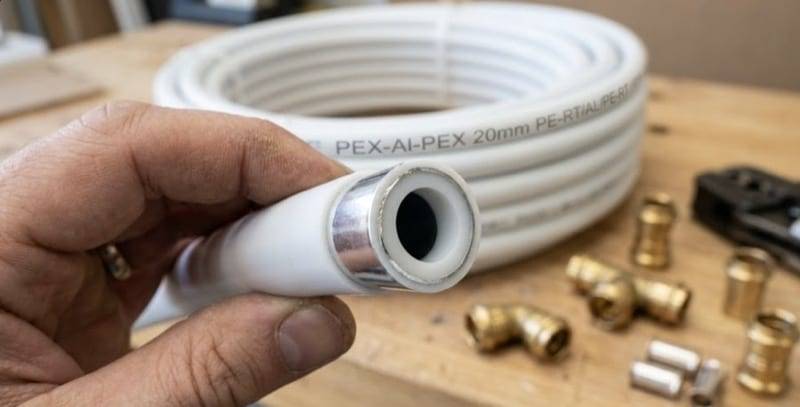
Multilayer pipes consisting of an aluminium layer between two layers of polyethylene (PEX or PE-RT). They combine the advantages of plastic pipes (corrosion resistance, smooth interior surface) with the advantages of metal pipes (rigidity, oxygen diffusion barrier, low thermal expansion). The most popular choice in modern single-family home installations.
The weight of multilayer pipes is given based on manufacturers' catalogue data.
| Designation | dext [mm] | s [mm] | dint [mm] | Pipe weight [kg/m] | Water cap. [l/m] | With water [kg/m] |
|---|---|---|---|---|---|---|
| 16x2,0 | 16,0 | 2,0 | 12,0 | 0,11 | 0,113 | 0,22 |
| 20x2,0 | 20,0 | 2,0 | 16,0 | 0,14 | 0,201 | 0,34 |
| 25x2,5 | 25,0 | 2,5 | 20,0 | 0,21 | 0,314 | 0,53 |
| 26x3,0 | 26,0 | 3,0 | 20,0 | 0,26 | 0,314 | 0,57 |
| 32x3,0 | 32,0 | 3,0 | 26,0 | 0,35 | 0,531 | 0,88 |
| 40x3,5 | 40,0 | 3,5 | 33,0 | 0,50 | 0,855 | 1,35 |
| 50x4,5 | 50,0 | 4,5 | 41,0 | 0,77 | 1,320 | 2,09 |
| 63x4,5 | 63,0 | 4,5 | 54,0 | 1,10 | 2,290 | 3,39 |
Summary
The choice of pipe material depends on the type of installation, operating conditions and budget:
- Steel pipes — the traditional choice for central heating and gas installations. The heaviest, but the most mechanically durable. Require welding or threading.
- Copper pipes — versatile, used in water supply, central heating and gas installations. Long service life, but high material cost.
- PP pipes — popular in water supply installations. Lightweight and inexpensive, but require thermal expansion compensation. PN16 for cold and hot water, PN20 for central heating.
- PEX pipes — ideal for underfloor heating and manifold-based installations. Flexible, easy to run in wall chases.
- PEX-Al-PEX pipes — combine the flexibility of PEX with the rigidity of aluminium. Minimal thermal expansion, built-in oxygen diffusion barrier. The most popular choice in new single-family homes.
Need to calculate the water volume in an installation or select a pipe diameter? Use our calculators:
Back to articles list