Voltage drop in electrical installations — how to calculate it and when it becomes a problem?
26 marca 2026 | Electrical
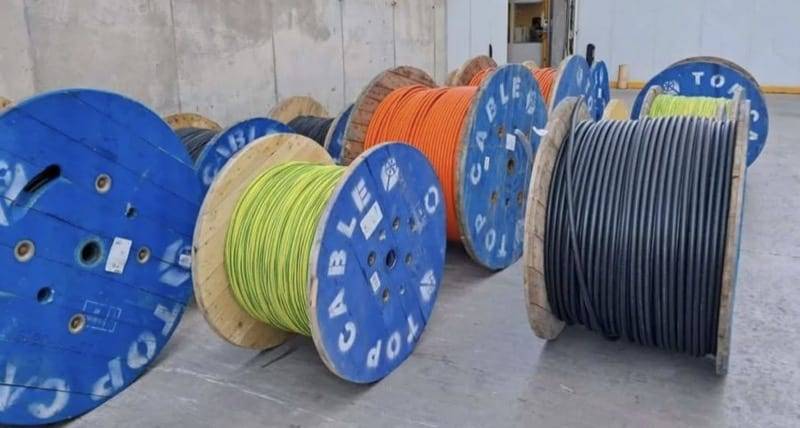
Every electrical cable resists the flow of current — the longer the cable and the higher the current, the more voltage is "lost" along the way. In domestic installations with short circuits, this issue is often overlooked. But a longer cable run, outdoor lighting, or a photovoltaic installation is all it takes for voltage drop to become the deciding factor in cable cross-section selection.
If you want to quickly check the voltage drop for a specific circuit, use our voltage drop calculator. Below we explain the theory, standards, and practical cases where voltage drop is of critical importance.
What is voltage drop?
Voltage drop is the difference in potential between the beginning and end of a cable, caused by its resistance (and reactance for larger cross-sections). If we have 230 V at the distribution board terminals and measure 218 V at a socket in a workshop 50 m away — the voltage drop is 12 V, or 5.2%.
Consequences of excessive voltage drop:
- flickering or dimming of lighting — particularly noticeable with LEDs,
- reduced motor power — torque drops with the square of voltage,
- equipment starting problems — motors, compressors, and heat pumps may fail to start,
- cable overheating — at reduced voltage, equipment draws higher current to maintain power,
- damage to sensitive electronics — switch-mode power supplies may operate erratically.
Permissible voltage drops according to standards
Standard PN-HD 60364-5-52 (and its Polish equivalent) defines maximum voltage drops in consumer installations, measured from the point of supply to the load:
| Supply source | Lighting | Other loads |
|---|---|---|
Type A — public network supply | 3% | 5% |
Type B — private source supply (generator, UPS) | 6% | 8% |
These values apply to the entire route from the point of supply to the load. In practice, this means that the voltage drop on the main supply line (riser cable) and on the final circuit adds up — as we discuss in the section on cascading drops.
The standard allows increasing the above limits by 0.005% for each metre beyond 100 m of route length, but by no more than an additional 0.5%.
Voltage drop formulas
Simplified formula (resistance only)
For most installations with cross-sections up to 50 mm², the cable reactance is negligibly small and a formula considering only resistance is sufficient.
Single-phase circuit (230 V):
Three-phase circuit (400 V):
where:
— load current [A]
— cable length (one way) [m]
— material conductivity [m/(Ω·mm²)]
— cable cross-section [mm²]
— nominal voltage [V]
Exact formula (with reactance)
For cross-sections of 70 mm² and above, the inductive reactance of the cable becomes significant, especially under inductive loads (motors). The full formula:
Single-phase circuit:
Three-phase circuit:
where:
— unit resistance of the cable [Ω/m]
— unit reactance of the cable [Ω/m] (typically 0.08 mΩ/m for cables)
— load power factor
Conductivity of cable materials
Conductivity depends on the operating temperature of the cable. The values below account for the conductor operating temperature:
| Material | γ at 20°C | γ at PVC (70°C) | γ at XLPE (90°C) |
|---|---|---|---|
| Copper (Cu) | 56.0 | 44.4 | 42.4 |
| Aluminium (Al) | 35.0 | 27.5 | 26.3 |
In voltage drop calculations, the conductivity corresponding to the cable operating temperature (70°C or 90°C) is used, not the ambient temperature. This gives a result on the "safe side" — the actual drop under lighter load will be lower.
Voltage drop tables — quick reference
The table below gives the voltage drop in %/(A·m) — simply multiply the value by the current and length to get the result in percent. Values for copper cables with PVC insulation (γ = 44.4):
Single-phase circuits 230 V
| Cross-section [mm²] | ΔU% per 1 A·m | Max A·m at 3% | Max A·m at 5% |
|---|---|---|---|
| 1.5 | 0.01305 | 230 | 383 |
| 2.5 | 0.00783 | 383 | 639 |
| 4 | 0.00490 | 612 | 1 020 |
| 6 | 0.00326 | 920 | 1 534 |
| 10 | 0.00196 | 1 531 | 2 551 |
| 16 | 0.00122 | 2 459 | 4 098 |
| 25 | 0.00078 | 3 846 | 6 410 |
| 35 | 0.00056 | 5 357 | 8 929 |
How to use the table: Multiply the load current [A] by the route length [m]. If the result (A·m) is less than the value in the "Max A·m" column, the voltage drop is within the limit.
Example: A 6 A lighting circuit, 22 m long, 1.5 mm² cable. Product: 6 x 22 = 132 A·m. The limit for 3% is 230 A·m — within the limit (drop: 132 x 0.01305 = 1.72%).
Three-phase circuits 400 V
| Cross-section [mm²] | ΔU% per 1 A·m | Max A·m at 5% |
|---|---|---|
| 2.5 | 0.00390 | 1 282 |
| 4 | 0.00244 | 2 049 |
| 6 | 0.00163 | 3 067 |
| 10 | 0.000975 | 5 128 |
| 16 | 0.000610 | 8 197 |
| 25 | 0.000390 | 12 821 |
| 35 | 0.000279 | 17 921 |
| 50 | 0.000195 | 25 641 |
Cascading voltage drops
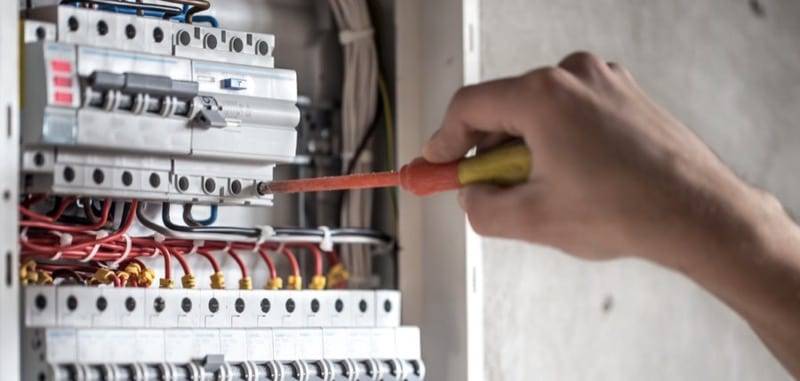
In a real installation, current flows through several cable sections: from the cable termination box, through the main supply line to the main distribution board, then to the floor distribution board, and from there to the load. The voltage drops on each section add up.
The standard requires that the total voltage drop from the point of supply to the load does not exceed the permissible values (3% or 5%).
Cascading example
Installation in a multi-family building:
Section 1 — main supply line (three-phase 400 V):
Current: 63 A, length: 25 m, cross-section: 25 mm² Cu/PVC
Section 2 — lighting circuit (single-phase 230 V):
Current: 8 A, length: 18 m, cross-section: 1.5 mm² Cu/PVC
Total:
Permissible limit for lighting: 3%. The result of 2.49% — condition met, but with little margin. Increasing the lighting circuit length to 22 m would already give 3.10% — exceeding the standard.
Voltage drop in photovoltaic installations (DC)
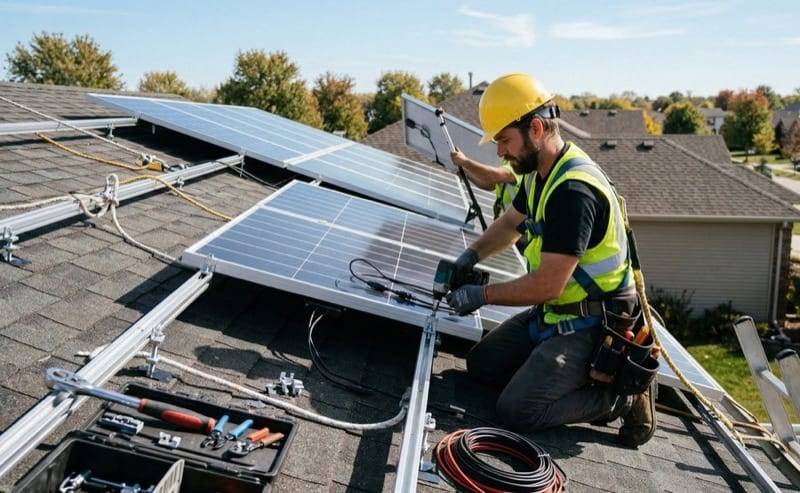
Photovoltaic installations are a special case — long cable runs on the direct current (DC) side from panels to the inverter, often outside the building. Every percent of voltage drop is a direct loss of installation power.
Formula for direct current (DC):
where:
— current at maximum power point [A]
— voltage at maximum power point [V]
— DC cable length (one way) [m]
The recommended voltage drop in PV installations is ≤ 1% on the DC side. Some standards allow 2%, but every additional percent is a real loss of annual energy production.
Example — 10 kWp PV installation
Data:
= 11.5 A (2 strings of 5 panels, voltage approx. 200 V)
= 200 V
= 25 m (panels on roof to inverter in garage)
Solar cable Cu 6 mm², γ = 56 (solar cable operates at a lower temperature than installation cable)
The 0.86% drop is within the recommended 1%. For a longer run (e.g. 40 m), a 10 mm² cross-section should be considered.
Voltage drop during motor starting
Electric motors draw 5 to 8 times their rated current during starting. This momentary current surge causes a significant voltage drop, which can:
- prevent motor starting (starting torque too low),
- cause lighting to flicker throughout the installation,
- disrupt the operation of other equipment on the circuit.
Example — heat pump motor
Data:
Compressor motor: = 16 A, starting current: = 6 x 16 = 96 A
Supply: three-phase 400 V
Length: 30 m, cross-section: 6 mm² Cu/PVC
Voltage drop during operation:
Voltage drop during starting:
A 4.68% drop during starting means the voltage at the motor terminals will fall to approximately 381 V. For motors sensitive to voltage drop (e.g. scroll compressors), this can cause starting problems. Solutions:
- increase the cross-section to 10 mm² (starting drop: 2.81%),
- use a soft starter or variable frequency drive (VFD), which limits starting current,
- shorten the cable run.
How to reduce voltage drop?
When the calculated voltage drop exceeds standards, there are several options:
1. Increase cable cross-section
The simplest solution — a thicker cable has lower resistance. Cost increases, but in many cases going up one cross-section size is sufficient.
2. Switch from single-phase to three-phase supply
Switching from 230 V to 400 V reduces the current by a factor of for the same power, and the three-phase formula yields a smaller drop:
| Parameter | 1-ph 230 V | 3-ph 400 V |
|---|---|---|
| Power 10 kW, cos φ = 0.95 | I = 45.7 A | I = 15.2 A |
| Cable 10 mm² Cu, L = 40 m | ΔU = 3.57% | ΔU = 0.59% |
| Drop ratio | — | 6x smaller |
Switching from single-phase to three-phase supply reduces the voltage drop by approximately 6 times for the same power and cross-section. This is particularly important for long cable runs to outbuildings or workshops.
3. Shorten the cable run
Voltage drop is directly proportional to length. Moving the distribution board closer to the load or routing the cable along a shorter path can solve the problem without changing the cross-section.
4. Split the load across more circuits
Instead of one circuit with high current — two circuits with lower current, each with a smaller voltage drop.
When does voltage drop determine the cross-section?
In practice, voltage drop becomes more restrictive than current-carrying capacity in the following situations:
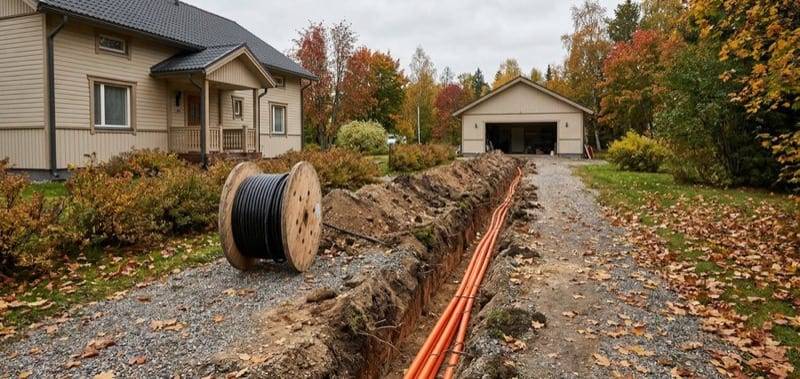
- long cable runs (over 30-40 m) — outdoor lighting, garages, outbuildings, industrial halls,
- lighting circuits — 3% limit instead of 5%,
- aluminium cables — conductivity 38% lower than copper,
- photovoltaic installations — recommended 1% limit on the DC side,
- motor supply — need to account for starting current,
- single-phase supply at high power — current is times higher than with three-phase supply.
In such cases, the voltage drop calculator will help you quickly determine whether the chosen cross-section is sufficient. If you need to select the entire circuit from scratch (including current-carrying capacity and correction factors), use the cable sizing calculator.
Summary
Voltage drop is a phenomenon that rarely poses a problem in short domestic circuits — but for longer cable runs, lighting, PV installations, or motor supply, it becomes a key design criterion. The most important rules:
- Always check the voltage drop for cable runs over 30 m,
- Sum the drops in cascade — main supply line + final circuit,
- For PV installations, aim for a drop of ≤ 1% on the DC side,
- For motors, account for starting current (5-8 x ),
- Three-phase supply reduces the drop by approx. 6x compared to single-phase,
- Bonus: increasing the cross-section due to voltage drop typically also improves fault protection conditions (lower fault loop impedance = faster protective device tripping).
Use our voltage drop calculator to check the voltage drop for any circuit — just enter the power, voltage, length, and cable cross-section.
Back to articles list