
Pipe Water Capacity and System Water Volume — Formula, Table, Calculator
11 maja 2026 | Pipes
A fitter filling up the system wonders "how much glycol to pour in". A designer sizing the expansion vessel asks "what is the system water volume". A building administrator — "do I need a DHW circulation loop". Each of these questions boils down to the same thing: how many liters of water fit inside the pipes. Pipe capacity is easy to calculate, but in practice there are a few traps that can throw the result off by tens of percent — mainly confusing the nominal diameter with the inside diameter and ignoring the capacity of manifolds, radiators and heat exchangers.
This article gives you the pipe-capacity formula, a ready table of unit capacities for five common materials (steel, copper, PP, PEX, PE), five typical applications of these calculations, and a full worked example — a mixed central-heating system in a single-family house with a system water volume of about 120 dm³. If you have several sections of different diameters, use the pipe capacity calculator — it sums up multiple rows with different materials in a single view.
Pipe capacity versus system water volume
In design practice these two concepts are often confused, but they cover different things:
- Pipe capacity is the internal volume of a pipe section — a purely geometric value that depends on the inside diameter and the length . Expressed in dm³, i.e. liters.
- System water volume (, total water content of the installation) is the combined capacity of every element that holds the working fluid: supply and return pipes, radiators or underfloor heating loops, the boiler heat exchanger, manifolds, the buffer tank, and any hydraulic separators. The expansion vessel is not included in the system water volume — it compensates for the rest.
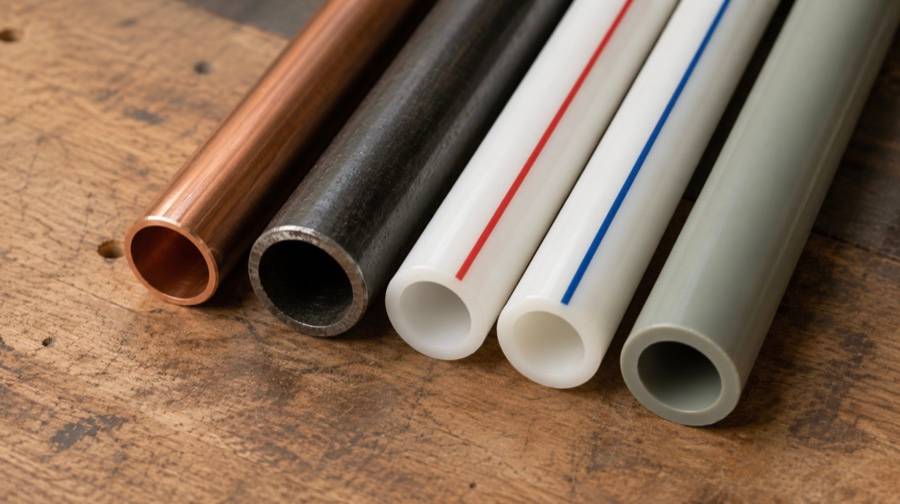
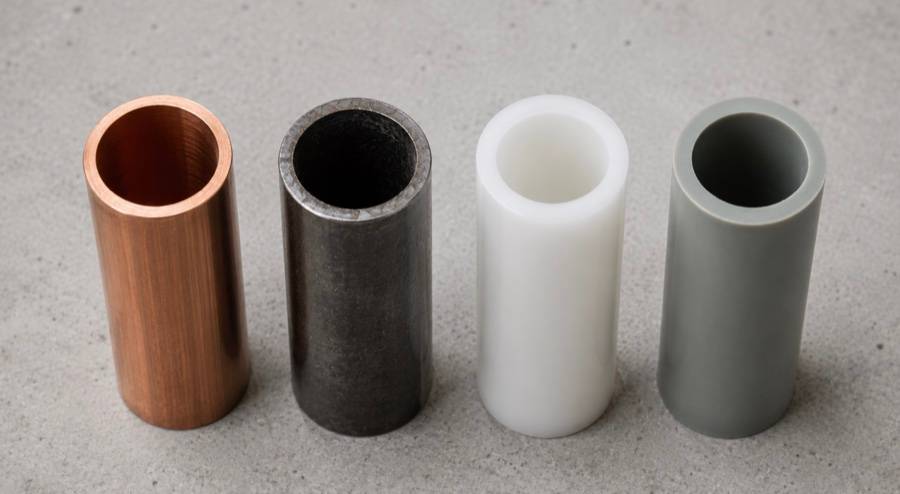
The second trap is geometric: the nominal diameter in the pipe designation is not the same as the inside diameter. You must check the wall thickness and subtract it twice. For the same "22 mm" we get very different results:
- copper pipe 22 × 1.5 mm — mm (the size range used in the calculator; 22 × 1.0 with mm also exists, but 22 × 1.5 is the standard in heating installations),
- PP PN20 pipe 25 × 4.2 mm — mm,
- steel pipe DN20 (Ø26.9 outside) — mm,
- PEX pipe 20 × 2.0 mm — mm.
Full pipe size ranges with wall thicknesses are listed in the article Pipe diameter table.
Pipe capacity formula
The capacity of a pipe section is calculated from the cross-section area and the length:
Where:
- — pipe capacity [dm³, i.e. liters],
- — inside diameter [dm],
- — section length [dm].
In practice it is more convenient to work in mm and meters. After converting the units (mm² times m divided by 1000 gives dm³) we get a site-friendly form:
For rough estimates we assume that 1 dm³ of water weighs 1 kg. Water density at typical operating temperatures (4-90 °C) changes by less than 4%, so the approximation is good enough for estimating the mass of water in the system. The same applies to a water–glycol mixture at the usual 25-40% concentrations — the error is no more than a few percent. If you would rather not do the math by hand, the pipe capacity calculator has built-in inside diameters for every common pipe range.
Unit-capacity table — liters per running meter
The table below gives the capacity in dm³/m for the most common pipe ranges. The values are consistent with the database used by the pipe capacity calculator, so the result from this article and the result from the calculator will agree to the third decimal place.
| Material | Size | [mm] | Capacity [dm³/m] |
|---|---|---|---|
| Black steel | DN15 (1/2") | 17.3 | 0.235 |
| Black steel | DN20 (3/4") | 22.3 | 0.390 |
| Black steel | DN25 (1") | 28.5 | 0.638 |
| Black steel | DN32 (5/4") | 37.2 | 1.086 |
| Black steel | DN50 (2") | 54.5 | 2.332 |
| Copper | 15 × 1.0 | 13.0 | 0.133 |
| Copper | 18 × 1.0 | 16.0 | 0.201 |
| Copper | 22 × 1.5 | 19.0 | 0.283 |
| Copper | 28 × 1.5 | 25.0 | 0.491 |
| Copper | 35 × 1.5 | 32.0 | 0.804 |
| PP PN20 | 20 × 3.4 | 13.2 | 0.137 |
| PP PN20 | 25 × 4.2 | 16.6 | 0.216 |
| PP PN20 | 32 × 5.4 | 21.2 | 0.353 |
| PEX-Al-PEX | 16 × 2.0 | 12.0 | 0.113 |
| PEX-Al-PEX | 20 × 2.0 | 16.0 | 0.201 |
| PEX-Al-PEX | 25 × 2.5 | 20.0 | 0.314 |
| PE100 SDR17 PN10 | 32 × 2.0 | 28.0 | 0.615 |
| PE100 SDR11 PN16 | 32 × 3.0 | 26.0 | 0.531 |
For sizes outside this list (e.g. DN10, 3/8") or pipes with a non-standard wall thickness, use the "Custom diameter" option in the pipe capacity calculator — just enter the inside diameter in mm and the length in meters.
Application 1: heating system water volume and expansion vessel sizing
Pipe capacity is the starting point for calculating the usable capacity of the expansion vessel per PN-B-02414. The full sizing algorithm is described in the article Sizing the diaphragm expansion vessel for a heating system; here we are interested only in the input to that calculation, namely — the system water volume.
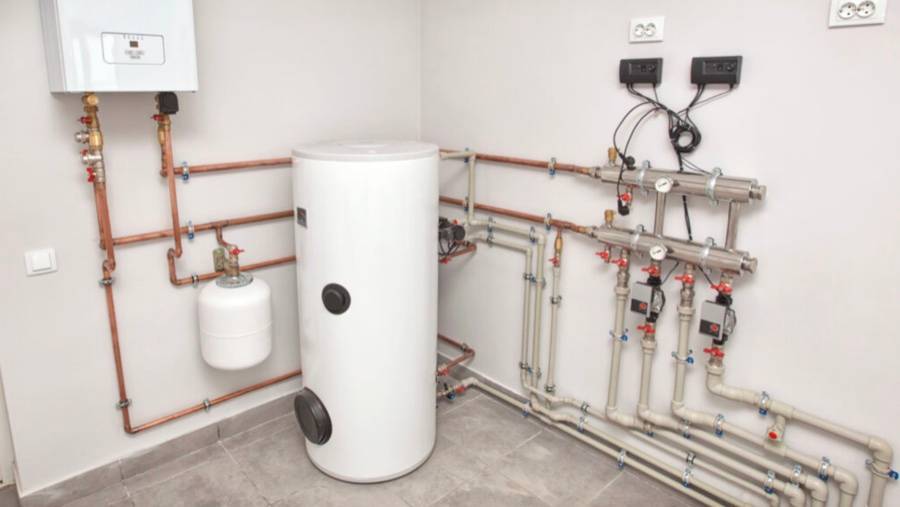
The water volume of a central-heating system consists of:
- supply and return pipes (lengths counted separately, because the routes are usually different),
- panel radiators, sectional radiators, underfloor loops — values from the manufacturer's catalog,
- the boiler heat exchanger or heat pump (from the device's documentation),
- underfloor-heating manifolds,
- the buffer tank, if it is in the primary circuit,
- any hydraulic separator.
Indicative capacities of typical components:
| Component | Typical capacity |
|---|---|
| Panel radiator 600 × 1000 type 22 | ~4.5 dm³ |
| Panel radiator 600 × 1000 type 33 | ~6.5 dm³ |
| Aluminum sectional radiator 500/100 (1 section) | ~0.4 dm³ |
| Condensing boiler heat exchanger, 24 kW | ~1.5-3 dm³ |
| Underfloor loop PEX 16 × 2 mm, 100 m | ~11.3 dm³ |
| Buffer tank 200 l | ~200 dm³ |
The values in this table are indicative — in a real project, take radiator and heat-exchanger capacities from the specific manufacturer's documentation. Once you have the system water volume, move on to the expansion vessel sizing calculator — it returns the usable and nominal vessel capacity and the required diaphragm pre-charge pressure.
Application 2: when DHW circulation is required
The current Warunki Techniczne (Polish Technical Conditions, §120) require a continuous DHW circulation loop in buildings other than single-family, farm and individual-recreation buildings if the water capacity of the supply pipe to a draw-off point exceeds 3 dm³. In single-family homes circulation is not mandatory, although it is good practice for comfort (shorter wait for hot water at the tap) and hygiene (limiting the growth of Legionella bacteria, which multiply in stagnant water at 25-45 °C).
The 3 dm³ threshold translates to specific branch lengths depending on the material and diameter:
| Pipe | Capacity [dm³/m] | Length up to 3 dm³ |
|---|---|---|
| PP PN20 25 × 4.2 (Ø16.6 inside) | 0.216 | ~13.9 m |
| Cu 18 × 1.0 (Ø16.0 inside) | 0.201 | ~14.9 m |
| PEX 20 × 2.0 (Ø16.0 inside) | 0.201 | ~14.9 m |
| PP PN20 32 × 5.4 (Ø21.2 inside) | 0.353 | ~8.5 m |
In practice this means that in typical PP/Cu/PEX installations in multi-family buildings circulation becomes mandatory at a branch length of about 15 m to the farthest draw-off point. On the regulatory side, work is underway to tighten the requirements on Legionella protection — the details of the changes introduced in 2026 are discussed in the article New Polish Technical Conditions 2026. Before designing a specific installation, always check the current wording of the paragraph in the regulation in force.
Application 3: water mass, statics and supports
Since 1 dm³ of water ≈ 1 kg, the mass of water in the installation in kilograms is practically equal to the capacity in liters. Why does a designer need this information:
- selecting hangers and clamps for large-diameter pipes (DN50 and above), especially steel and copper risers,
- floor statics when locating a buffer tank (a 500 l tank plus water plus casing is more than 600 kg of point load),
- mounting cast-iron radiators — water-filled sections can weigh more than 100 kg for a 12-section radiator.
For a steel DN50 riser (2.332 dm³/m) the water alone in 10 m is about 23 kg; at DN100 (9.0 dm³/m) it is already 90 kg per 10 m.
Application 4: dosing glycol and corrosion inhibitor
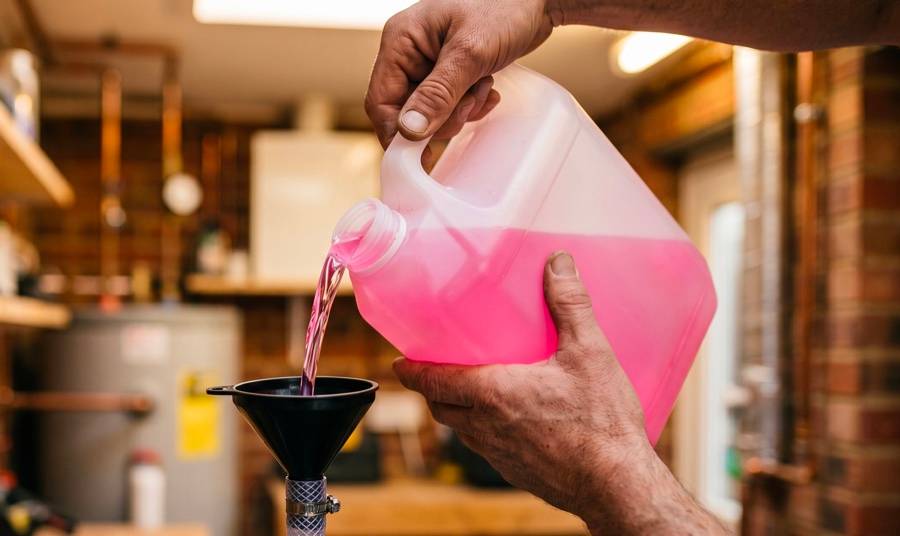
In air-to-water heat pumps, solar collectors and cooling loops, ethylene or propylene glycol is used at a volumetric concentration of 25-40%, depending on the minimum ambient temperature. Details on heating fluids can be found in the article Heating fluids.
The amount of glycol is calculated directly from the system water volume:
where is the volumetric concentration (e.g. 0.33 for protection down to -20 °C in propylene glycol). For a system water volume of 150 dm³ at 33% that is about 50 l of concentrate — buy 60 l to leave some margin for bleeding the system. Corrosion inhibitor is usually dosed at 1-2% of the system water volume (check the product datasheet); always round up.
Application 5: filling and flushing time
The filling time is simply the system water volume divided by the flow rate of the filling valve: . A 1/2" garden tap gives 10-15 dm³/min, a flushing pump 30-100 dm³/min. For a system water volume of 350 dm³ filled from a 12 dm³/min tap, it will take about 29 minutes. Flushing underfloor heating requires pumping 2-3 loop volumes through.
Full example — heating system in a single-family house
A single-family house with a floor area of 150 m², 24 kW condensing boiler, design parameters 55/45 °C, mixed system: panel radiators on the upper floor and underfloor heating on the ground floor.
Input data:
- heating risers and horizontal runs (supply and return combined): PP PN20 25 × 4.2 — 60 m,
- branches to radiators: PEX 16 × 2 mm — 80 m,
- underfloor heating loops: PEX 16 × 2 mm, 6 loops of 80 m each — 480 m,
- panel radiators: 8 units of about 5 dm³ each — 40 dm³,
- boiler heat exchanger: 2 dm³,
- underfloor manifolds: 2 units of 3 dm³ each — 6 dm³.
Step-by-step calculations:
- Capacity of PP PN20 25 × 4.2 pipes: .
- Capacity of PEX 16 × 2 branches: .
- Capacity of PEX 16 × 2 underfloor loops: .
- Total pipe capacity: .
- Components (radiators + heat exchanger + manifolds): .
| Pipe capacity | 76.24 dm³ |
|---|---|
| Component capacity | 48.00 dm³ |
| System water volume | ≈ 124 dm³ |
What to do with this:
- Water mass: ≈ 124 kg — relevant for riser supports, but in a typical single-family house it does not require floor reinforcement.
- 33% glycol: — buy 50 l (10 canisters of 5 l) to leave a margin for bleeding.
- Expansion vessel: in the expansion vessel sizing calculator enter the system capacity as (i.e. 124 dm³) — for 55/45 parameters and 1 bar static pressure, typically a 12-18 l vessel will be selected.
- Filling time from a 12 dm³/min tap: ≈ 10 minutes.
The fastest way to sum sections of different diameters is the pipe capacity calculator — add a new row for each route, pick the material from the list and the calculator will automatically sum the capacity of all sections.
Most common mistakes
- Calculating capacity from the nominal diameter. "22 mm" in the name of a copper pipe is the outside diameter — the inside diameter is 19 mm for the 22 × 1.5 range. Using the nominal diameter overestimates capacity by about 25%.
- Skipping underfloor heating loops. The "long but thin" argument is misleading — in a typical single-family house with underfloor heating they make up the largest share of the system water volume (in our example 54 out of 124 dm³, i.e. 44%).
- Forgetting the heat exchanger, manifolds and hydraulic separators. Each of these items adds anywhere from a few to a dozen-plus liters; systematically skipping them underestimates the system volume and the expansion vessel.
- Assuming the buffer tank in the heating circuit is just an add-on. A 200 l buffer in a house with a heat pump can make up the bulk of the entire system water volume — count its full capacity in.
- Confusing system water volume with the expansion vessel capacity. The vessel has a usable capacity of 6-10% of the system water volume — it is not counted as part of the system water volume, it is a compensator.
- Rounding 1 dm³ of glycol = 1 kg at concentrations above 50%. Pure propylene glycol has a density of ~1.04 g/cm³, ethylene glycol ~1.11 g/cm³. At 25-40% concentrations the error is below 5% and has no practical relevance, but when ordering pure glycol in 200 l drums you have to allow for the difference.
- No margin when buying glycol and inhibitor. "I'll buy exactly what I need" usually ends with running 2-3 liters short at the end of filling.
Frequently asked questions
How do I calculate the capacity of a 22 mm copper pipe?
A 22 mm copper pipe with the typical 1.5 mm wall thickness has an inside diameter of 19 mm. Capacity: dm³/m. For 22 × 1.0 mm the inside diameter is 20 mm and the capacity 0.314 dm³/m. Always check the wall thickness in the manufacturer's size range.
How much water fits in 100 m of PEX 16 × 2 pipe?
100 m times 0.113 dm³/m gives 11.3 dm³ — that is how much water a typical 100 m underfloor heating loop contains.
What is the system water volume and how do I calculate it?
The system water volume is the total water capacity of the installation: pipes (supply + return), radiators or underfloor loops, the boiler heat exchanger, manifolds, the buffer tank. The expansion vessel is not included — it compensates for the change in water volume during operation.
When does a DHW installation require a circulation loop?
The Warunki Techniczne in force (§120) require circulation in buildings other than single-family, farm and individual-recreation buildings if the water capacity of the supply pipe to a draw-off point exceeds 3 dm³. For typical PP/Cu/PEX pipes this corresponds to a length of about 15 m. In single-family homes circulation is not mandatory, although it is often good practice — the regulatory changes are discussed in the article New Polish Technical Conditions 2026.
How much glycol should I pour into a 150-liter system?
For 33% concentration (protection to -20 °C in propylene glycol): l of concentrate. In practice, buy 60 l — a few liters will be lost during bleeding.
Does pipe capacity depend on the material?
Yes, but indirectly — through wall thickness. A 25 mm pipe in PEX, PP and copper has different inside diameters (and therefore capacities) because the wall thickness is dictated by the manufacturing technology and the nominal pressure rating. The water inside behaves the same regardless of the wall material.
How do I calculate the mass of water in the system?
Capacity in liters (dm³) is practically equal to the mass of water in kilograms. A system water volume of 124 dm³ = 124 kg of water. For a water–glycol mixture the approximation remains good at 25-40% concentrations (error of a few percent).
Summary
Pipe capacity is a simple geometric calculation, but it underpins several design decisions: sizing the expansion vessel, estimating how much glycol and inhibitor is needed, checking whether DHW circulation is required, sizing supports and predicting the filling time. Three rules are enough to avoid the typical mistakes:
- capacity is calculated from the inside diameter, not the nominal one — check the manufacturer's size range,
- system water volume = pipes + radiators + heat source + accessories, but without the expansion vessel,
- 1 dm³ of water ≈ 1 kg — capacity in liters is practically the mass of water in kilograms.
The quickest path to the combined capacity of many pipe sections is the pipe capacity calculator — with built-in size ranges (steel, copper, PP PN16/PN20, PEX, PE100 SDR11/17, compressed-air pipes), the option to enter a custom diameter and automatic summing of multiple rows. After calculating the system water volume, move on to expansion vessel sizing or to sizing water supply pipe diameters if you are working on a DHW installation.
Back to articles list